


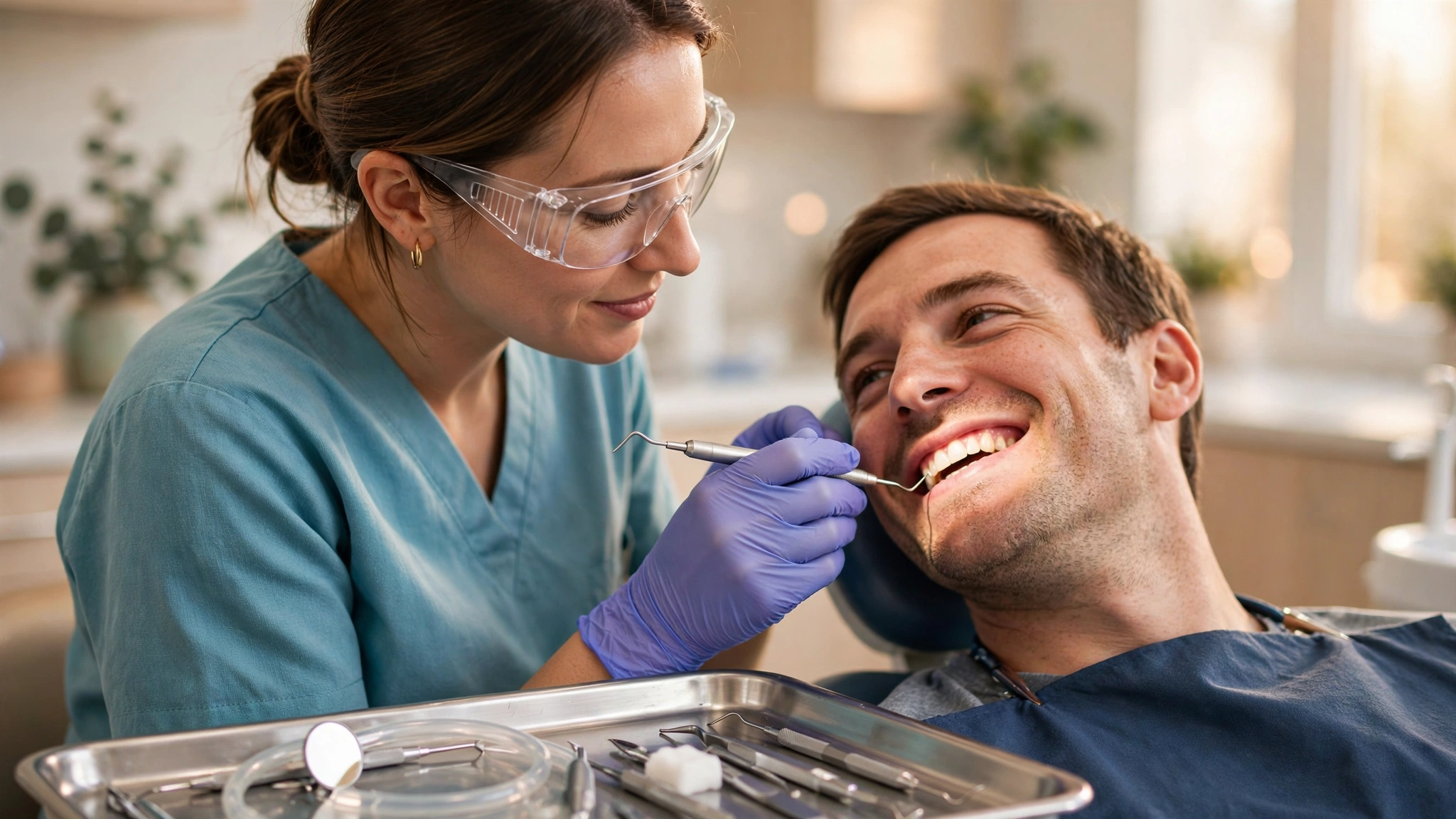
Yes. Paris Dental in Temecula provides professional teeth cleanings and comprehensive dental exams for adults and children. Regular checkups catch cavities, gum disease, and other issues early, when treatment is simplest. Call (951) 577-8090 to schedule your visit.
Care built around you
Routine cleanings and exams are the quiet foundation of lifelong oral health. Most dental problems — cavities, gum disease, cracked teeth — begin silently, and by the time they hurt, the treatment is bigger than it needed to be. At Paris Dental in Temecula, your cleaning and exam visits are unhurried: time to remove what brushing misses, time to look carefully, and time to answer your questions.
A healthy smile is not only about appearance, though that matters too. The mouth is connected to the rest of the body, and steady preventive care protects both your teeth and your overall health.
Is this the right care for me?
- It has been six months or more since your last cleaning
- Your gums bleed when you brush or floss
- You notice persistent bad breath or a bad taste
- You have tartar buildup you cannot remove at home
- You are new to Temecula and need a dental home
- You want a baseline examination with x-rays
- You have children or family members due for checkups
What a professional cleaning includes
Even careful brushing and flossing leave plaque in hard-to-reach areas, and within days that soft plaque hardens into tartar that only professional instruments can remove. Your hygienist uses ultrasonic and hand instruments to clear tartar above and slightly below the gumline, then polishes the teeth smooth. Polishing removes surface stain and leaves the enamel less welcoming to new plaque.
The cleaning also includes a gum assessment. The hygienist measures the small spaces between your teeth and gums; healthy measurements are shallow, while deeper readings signal gum inflammation or disease that needs attention. These measurements are recorded at each visit so changes are caught early, when treatment is simplest.
Exams, x-rays, and catching issues early
The examination is where small issues are found before they become big ones. Dr. Azim checks each tooth for decay, cracks, and worn restorations, evaluates existing fillings and crowns, screens the soft tissues for anything unusual, and assesses your bite. Digital x-rays are taken when diagnostically useful — for new patients, to see between teeth where the eye cannot reach, or to monitor a specific concern.
Early detection changes outcomes. A small cavity found at an exam needs a simple filling; the same cavity found a year later may need a crown or root canal. That difference in cost, time, and tooth preservation is the entire argument for regular exams.
Fluoride and sealants
Fluoride strengthens enamel and helps reverse the earliest stage of decay before a cavity forms. While most associated with children, adults with cavity risk factors — dry mouth, gum recession, frequent snacking, or a history of decay — benefit from periodic professional fluoride applications. It takes minutes and requires no recovery.
Sealants are thin protective coatings painted into the grooves of back teeth, where most cavities start. They are most common for children and teens, but adults with deep grooves and no existing decay can benefit as well. Both are simple preventive steps discussed at your exam based on your individual risk.
Gum health and whole-body risk
Gum disease is the leading cause of adult tooth loss, and it rarely hurts until it is advanced. Bleeding gums are not normal — they are an early warning. Left untreated, inflammation progresses from reversible gingivitis to periodontitis, where bone supporting the teeth is lost.
Research continues to link chronic gum inflammation with wider health risks, including cardiovascular strain and poorer blood sugar control. This does not mean gum disease causes those conditions, but it is one more reason steady preventive care matters. If measurements show disease, scaling and root planing — a deeper therapeutic cleaning — is recommended, and referrals are made when specialist periodontal care is appropriate.
Children’s checkups in Temecula
Children benefit from the same unhurried approach, scaled to smaller patients. A first dental visit is kept short and positive — a ride in the chair, a look around with the mirror, and a polish if the child is willing. The goal is familiarity, not endurance. As children grow, exams track tooth development, jaw growth, and bite alignment, while cleanings keep young smiles healthy and build the habit of regular care.
Parents often ask when to start. A good rule is the first visit by the first birthday, or when the first tooth appears. Early visits also give parents practical guidance on brushing technique, fluoride, thumb habits, and what to do if a tooth is injured. Children who grow up comfortable at the dentist tend to become adults who keep their teeth.
What happens when preventive care is skipped
Skipping cleanings rarely feels consequential in the moment, which is exactly why issues accumulate quietly. Plaque hardens into tartar, gums inflame and recede, and small cavities grow toward the nerve. By the time a skipped-checkup tooth starts hurting, the treatment is often a crown or root canal instead of a small filling — more time, more cost, and more tooth structure lost.
There is also a compounding effect. Gum disease makes diabetes harder to control; dry mouth from medications accelerates decay; worn teeth crack under normal chewing. Each of these is manageable when caught early and expensive when ignored. Regular exams are the least costly dental care there is, measured over a lifetime of keeping your natural teeth.
Your visit
We begin with your health history, concerns, and an examination. Your hygienist performs the cleaning, Dr. Azim completes the examination and reviews any x-rays with you, and findings are explained in plain language with appropriate options. Treatment is planned after an examination and appropriate imaging. Referrals are recommended when specialist care is appropriate.
What cleanings and examinations cost
A routine cleaning and a deep cleaning are different treatments at different fees. If your gums are healthy you need the first; if there is periodontal disease you need the second, and the examination determines which.
| Treatment | Current price | Included in price | Potential additional costs |
|---|---|---|---|
| New-patient examination (per visit) | $195 | Full-mouth examination, radiographs and a written treatment plan | Deep cleaning is separate |
| Routine cleaning (prophylaxis) (per visit) | $205 | Scale and polish for healthy gums | Deep cleaning is separate if gum disease is present |
| Deep cleaning (per quadrant) | $195 | Scaling, root planing and polishing of one quadrant | Laser periodontal treatment is not included |
| Periodontal maintenance (per visit) | $295 | Periodontal probing and maintenance cleaning | Laser treatment is not included |
| Fluoride treatment (per visit) | $45 | Full-mouth fluoride application | Fillings are separate |
| Intraoral radiograph (per film) | $25 | One intraoral film | Full-mouth series or emergency imaging charged separately |
| Panoramic radiograph (per image) | $195 | One panoramic image | Full-mouth intraoral series charged separately |
Fees apply to the treatment scope shown in the same row. An examination determines the care recommended and the final estimate, and any additional procedure is itemised before treatment starts.
See the full treatment price list for every fee we publish.
Plan with confidence
Ask for a written treatment estimate and confirm insurance benefits or membership eligibility before proceeding. All PPO plans are accepted; most cover preventive cleanings and exams, and our team verifies your benefits as a courtesy. Explore payment options or request an appointment.
Call (951) 577-8090 or visit Paris Dental at 31285 Temecula Pkwy Ste 205, Temecula, CA 92592, United States.
Common questions
How often should I have a cleaning and exam?
Most adults do well with a cleaning and examination every six months. If you have gum disease, heavy tartar buildup, or certain medical conditions, Dr. Azim may recommend three- or four-month intervals. The right frequency is set after your examination, not by a fixed rule.
Do dental cleanings hurt?
Routine cleanings are comfortable for most patients. If your gums are inflamed or you have not had a cleaning in a long time, there can be some tenderness, and numbing options are available. Tell the hygienist about any sensitivity so the visit can be adjusted.
Are dental x-rays safe?
Modern digital x-rays use a very small amount of radiation — far less than film x-rays of the past — and a lead apron with thyroid collar is used as standard. X-rays are taken only when diagnostically useful, such as for new patients, to check between teeth, or to monitor a specific concern.
What is the difference between a regular cleaning and a deep cleaning?
A regular cleaning removes plaque and tartar above the gumline. A deep cleaning, called scaling and root planing, cleans below the gumline and smooths root surfaces when gum disease is present. It is a therapeutic treatment, usually done with numbing, and is recommended only when measurements show it is needed.
Do adults need fluoride treatments?
Fluoride is not only for children. Adults with a history of cavities, dry mouth, gum recession, or multiple restorations often benefit from periodic fluoride applications. Dr. Azim recommends it based on your individual cavity risk, assessed at your examination.