



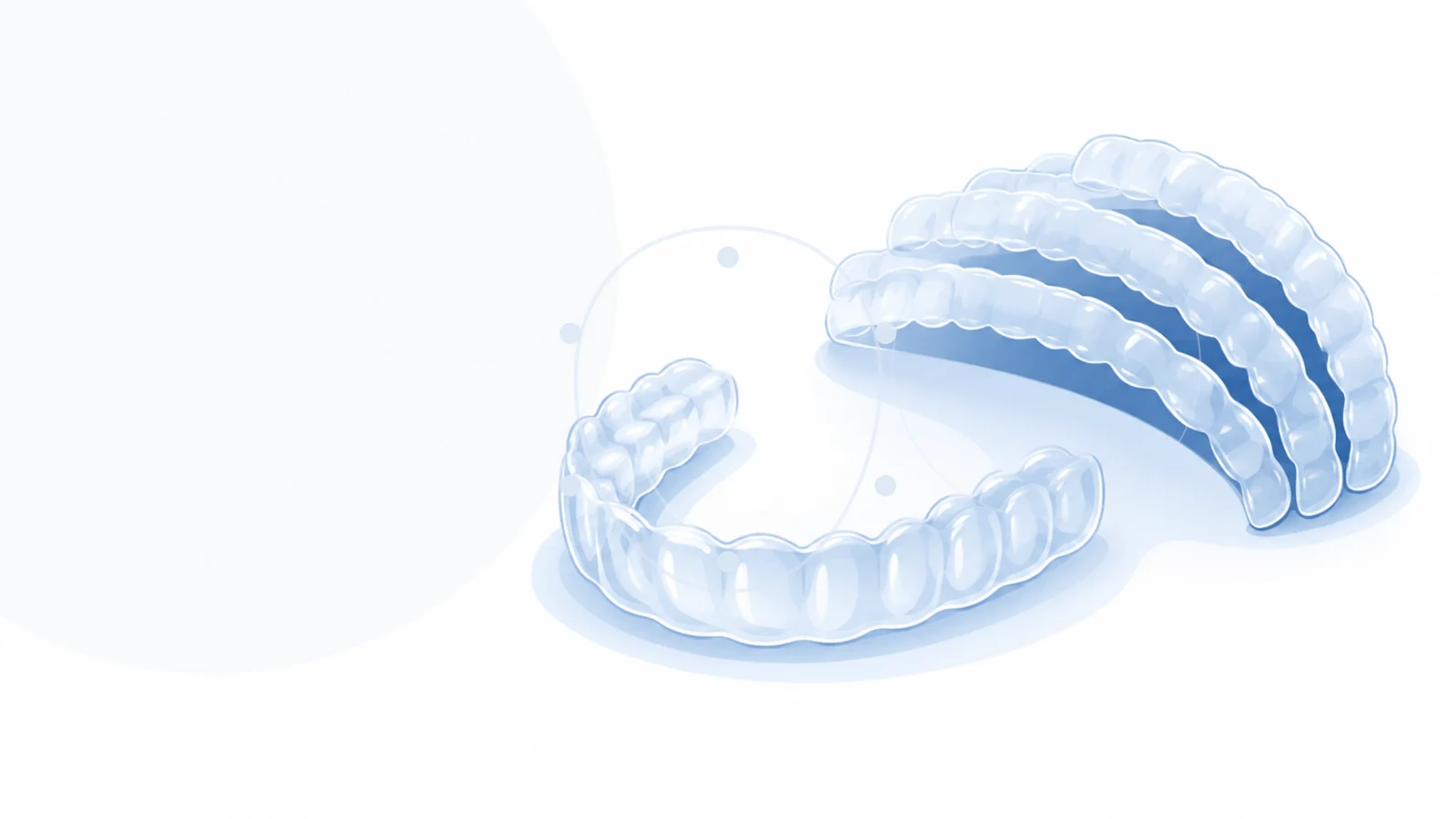
Full clear aligner treatment at Paris Dental is $4,995, and it includes the retainer you wear afterwards, any attachments, and every refinement aligner. Limited treatment for a minor correction is $2,995. You also see a digital preview of the predicted result before you commit, at no charge.
Key facts
| Detail | |
|---|---|
| Full treatment | $4,995, all-inclusive |
| Limited or express treatment | $2,995 |
| Retainer afterwards | Included in the fee |
| Attachments and refinements | Included in the fee |
| Digital preview before starting | Included, no charge |
| Daily wear target | 22 hours a day |
| Aligner systems used | ClearCorrect and Invisalign |
| Insurance | Some plans include an orthodontic benefit; we check before you start |
Is Invisalign cheaper than braces?
No. At this practice metal braces are $4,595 and ceramic braces are $4,995.
The comparison is closer than the headline numbers suggest, though, because the aligner fee is all-inclusive. A retainer costs $295 per arch when bought on its own, and with braces retainers are included. So the gap between metal braces at $4,595 and aligners at $4,995 is $400 — and that $400 buys a system you can remove, that is nearly invisible, and that is easier to clean around.
That is the honest reason to choose aligners. Not price. The way they fit into your life.
What the fee includes, and what it does not
The $4,995 covers the whole course:
- Planning and the digital preview, so you see the predicted result before anything starts.
- Attachments — the small tooth-coloured bumps bonded to certain teeth.
- Every aligner in the series, including refinement aligners if the result needs fine-tuning.
- The retainer afterwards.
Charged separately:
- Replacement aligners if a set is lost.
Ask for the written estimate before you begin, listing each item and what it covers. Very few practices quote an all-inclusive aligner fee, so it is worth asking any office you compare against whether their number includes the retainer — that is usually where a lower quote turns out not to be lower. Every fee we publish is on our treatment price list.
Does Invisalign actually work?
For the right case, yes — and there is good evidence about which cases those are.
The largest recent review pooled 21 randomised controlled trials covering 970 participants and compared clear aligners with fixed braces. For simpler cases treated without extractions, it found no significant difference in standard orthodontic outcome scores between the two: "there was no significant difference in the ABO objective grading scores, Little Irregularity Index and PAR scores between the fixed appliances and clear aligner treatments" (Baneshi et al., 2024).
That is a genuinely reassuring result for anyone weighing aligners against braces for mild to moderate crowding.
It comes with a caveat the same review states directly: "The overall quality of evidence from the included studies was low." The trials were small, and most carried an unclear risk of bias. So the finding is encouraging rather than settled.
Where braces are the better choice
Two situations, and both are measured rather than opinion.
When teeth need to come out. A second review, pooling 15 trials and 1,084 patients, found that "in extraction cases, fixed appliances provided superior treatment quality, attributed to enhanced control of tooth movements" (Alhafi et al., 2025).
When the case is complex. An overview of 18 systematic reviews concluded clear aligners were "effective for mild to moderate malocclusions, and was associated with inferior outcomes when treating severe cases or with achieving specific tooth movements" (Papadimitriou et al., 2021).
So the honest answer to "does Invisalign work" is: it depends entirely on what your teeth need to do. A mild crowding case and a case needing extractions are different problems, and they do not have the same answer.
Did you know: the 22-hour rule is not marketing
Aligners only move teeth while they are in your mouth. The clinical definition of compliance in the research is wearing them at least 22 hours a day, and the categories are unforgiving: fully compliant means hitting 22 hours on 75% or more of your trays, and "poorly compliant" means hitting it on fewer than half (Timm et al., 2022).
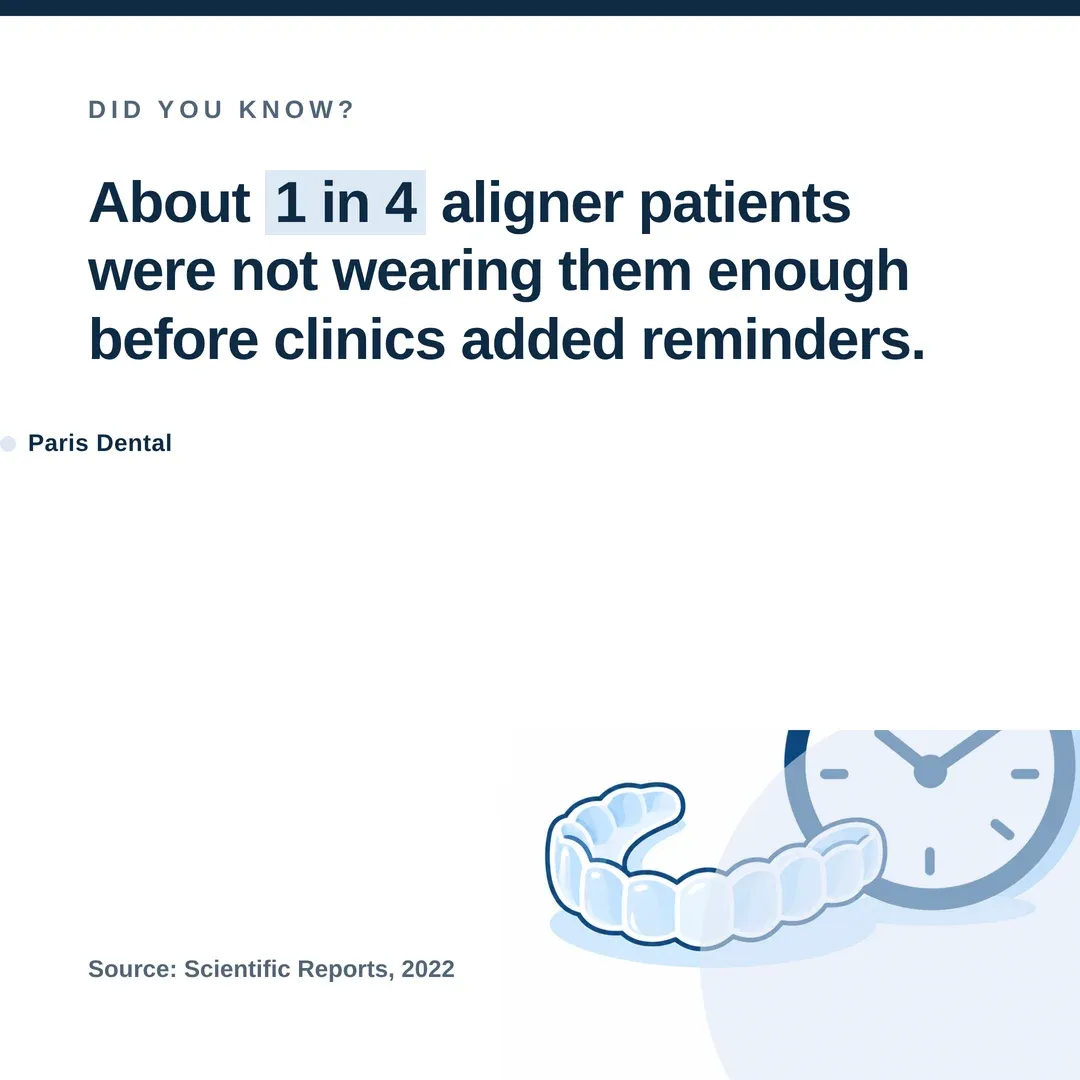
Did you know: about one patient in four was missing that target
That same study looked at a German clinic's records for 1,899 patients before it introduced electronic reminders and 5,486 after. Before the reminders, 24.47% were poorly compliant. After, poor compliance levelled off at 9.32%.
Two things follow. First, roughly a quarter of people were not wearing their aligners enough, which is the single most common reason a case runs past its predicted time. Second, a reminder is not a gimmick; it changed the number substantially.
Sources: https://link.springer.com/content/pdf/10.1038/s41598-022-20820-5.pdf
Did you know: aligners are easier on your gums
Across those 21 trials, plaque, gingival and bleeding scores were all significantly lower with aligners than with braces — "significantly lower in clear aligners when compared to the fixed appliances" (Baneshi et al., 2024). Patients also reported better quality of life at six months.
The review rates the gum evidence as low quality and the quality-of-life evidence as moderate, so treat this as a likely benefit rather than a guarantee. But it is consistent with the obvious mechanical reason: you take aligners out to brush, and there are no brackets to clean around.
Did you know: the hardest movements are rotation and tipping
A digital planning study that compared what was planned against what was achieved found that "inclination and rotation movements are the most challenging movements to control for upper laterals and for upper and lower premolars and canines" (PMC9840984).
This is why some cases need small tooth-coloured attachments — the little bumps bonded to certain teeth. They give the aligner something to grip so it can apply a rotational or tipping force it could not otherwise deliver.
Will my teeth move back afterwards?
Yes, and this is the part patients most often underestimate.
An overview of 18 systematic reviews found that "Relapse was greater with CAT" — greater with clear aligners than with fixed braces (Papadimitriou et al., 2021). A separate review found "limited evidence indicated similar post-treatment stability", while noting that short follow-up limited how firm that conclusion could be (Alhafi et al., 2025).
Whatever the precise comparison, the practical point is the same and it is not in dispute: retention is part of the treatment. With aligners at this practice the retainer is already in the fee, so there is no extra purchase to skip. Skipping it anyway is how people end up paying twice.
How we do it at Paris Dental
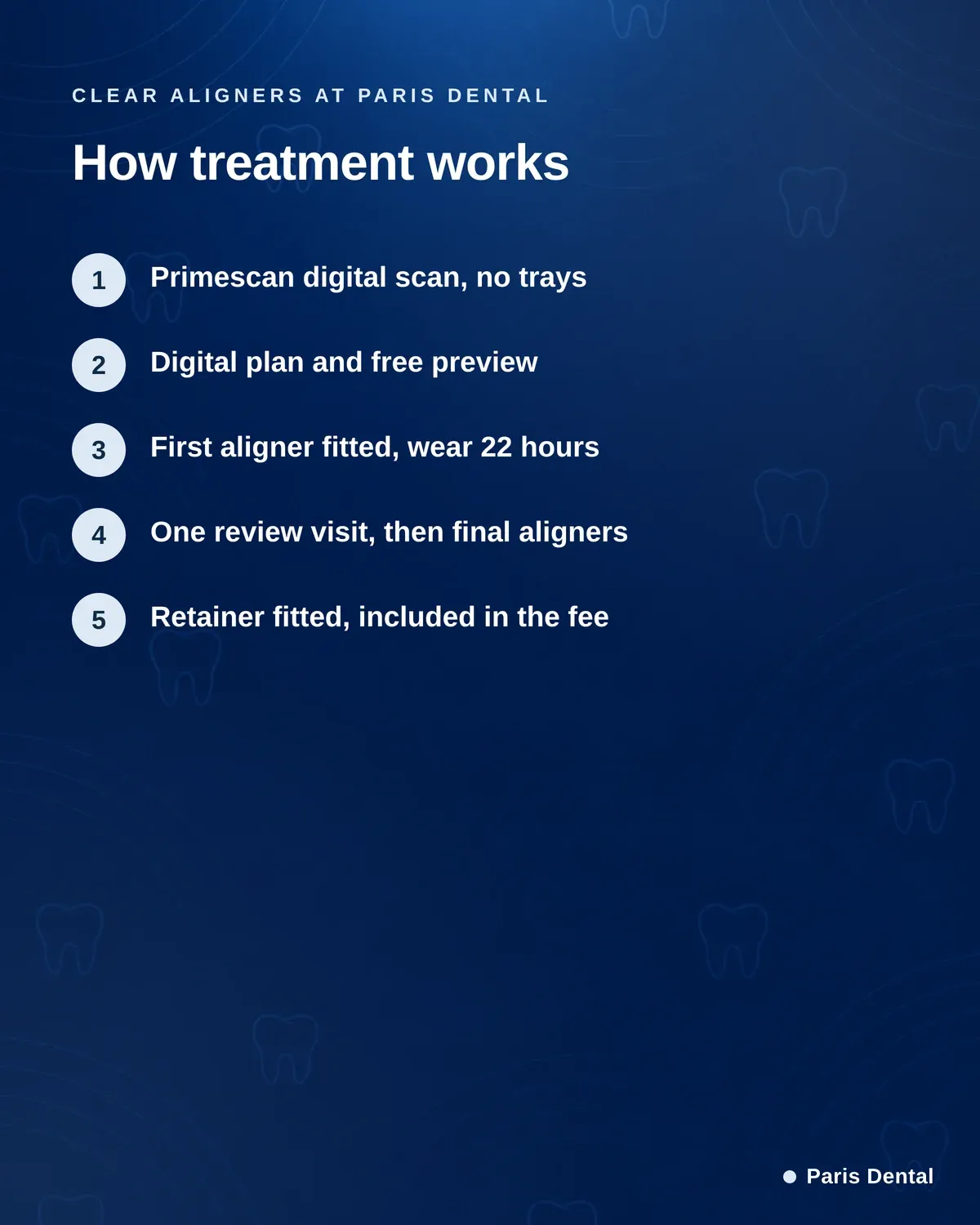
- Assessment and digital scan. We examine your bite and gum health, then scan your teeth with a Primescan intraoral scanner (Dentsply Sirona). No impression trays.
- Digital plan and preview. Your tooth movement is mapped before any aligner is made, and you see the predicted result at no charge before you decide.
- Fitting. The first aligner is fitted and you are shown how to insert, remove and clean it. Attachments are bonded where the plan needs them.
- Wear and monitor. You wear each aligner about 22 hours a day and change sets on schedule. There is one review visit in a full case, so the day-to-day discipline is yours — this practice does not use a remote monitoring app.
- Retainer. A retainer is made and fitted at the end. It is included in the fee.
What it costs, and how to pay for it
| Treatment | Fee |
|---|---|
| Clear aligner treatment, full — retainer, attachments and refinements included | $4,995 per case |
| Clear aligner treatment, limited or express | $2,995 per case |
| Metal braces | $4,595 per case |
| Ceramic braces | $4,995 per case |
| Retainer, when bought on its own | $295 per arch |
Some dental plans include an orthodontic benefit, often with a lifetime maximum separate from your annual maximum. We check your specific plan before treatment starts and give you the estimate in writing. A benefit check is an estimate, not a guarantee that your insurer will pay.
If cost is the obstacle, say so at the assessment rather than after. It is often possible to plan treatment in a way that spreads the cost, and that conversation is easier before anything is ordered.
When to call us
Call if an aligner cracks or a set is lost, if an attachment comes off, if a tray stops fitting, or if you have pain that is not settling after a few days of a new aligner.
Go to an emergency dentist or your doctor rather than waiting if you have facial swelling, trouble breathing or swallowing, or a tooth that has been knocked out. Those are not orthodontic problems.
If you want the service detail rather than the cost, see Invisalign and clear aligners at Paris Dental. For the wider comparison read Invisalign vs braces in Temecula, and if alignment is one part of a bigger plan, where to start with a smile makeover.
Call (951) 577-8090 to book an orthodontic assessment, or request a visit. We are open Monday to Friday, 10:00 am to 5:00 pm. An online request is not a confirmed appointment.
Sources
- Baneshi M, O'Malley LA, El-Angbawi AM, Thiruvenkatachari B. Effectiveness of clear orthodontic aligners in correcting malocclusions: a systematic review and meta-analysis. Journal of Evidence Based Dental Practice. 2024. https://pubmed.ncbi.nlm.nih.gov/39947778/
- Alhafi ZM, et al. Quality and stability of orthodontic treatment outcomes with clear aligners versus fixed appliances: a systematic review and meta-analysis. 2025. https://pubmed.ncbi.nlm.nih.gov/41127933/
- Papadimitriou A, et al. Clinical effectiveness of clear aligner treatment compared to fixed appliance treatment: an overview of systematic reviews. Clinical Oral Investigations. 2021. https://link.springer.com/article/10.1007/s00784-021-04361-1
- Timm LH, Farrag G, Wolf D, Baxmann M, Schwendicke F. Effect of electronic reminders on patients' compliance during clear aligner treatment: an interrupted time series study. Scientific Reports. 2022. https://link.springer.com/content/pdf/10.1038/s41598-022-20820-5.pdf
- Predictability of orthodontic tooth movement with aligners. PMC9840984. https://pmc.ncbi.nlm.nih.gov/articles/PMC9840984/
Results vary between patients. This article is general information and is not a substitute for an examination.
Common questions
Is Invisalign cheaper than braces?
At this practice, no — metal braces are $4,595 and full aligner treatment is $4,995. But the aligner fee includes the retainer, attachments and refinements, so compare like for like before deciding a quote elsewhere is cheaper.
Which aligner system do you use?
ClearCorrect and Invisalign. Both are clear removable aligner systems; which one suits your case is decided at the assessment.
How many hours a day do I have to wear them?
Twenty-two hours, which is the standard used in clinical research. That leaves about two hours a day for eating and cleaning your teeth. Below that, the planned movement does not express and the case takes longer.
Does Invisalign hurt?
Most people feel pressure and mild soreness for a day or two with each new tray, rather than pain. It settles. If it does not, tell us rather than waiting for the next scheduled visit.
Can I eat with them in?
No. Remove them to eat and to drink anything other than water, then brush before putting them back. Drinking hot drinks with them in can distort the plastic.
Can I see the result before I start?
Yes. Your teeth are scanned with a Primescan intraoral scanner and the predicted movement is shown to you before anything is ordered, at no charge.
Will my teeth move back afterwards?
They will try to. Relapse is documented and appears more likely with aligners than with braces, which is why the retainer is part of the treatment. Here it is included in the fee — so there is no reason to skip it.
Does insurance cover it?
Some plans include an orthodontic benefit, usually with its own lifetime maximum. We check before you commit and put the estimate in writing. Your insurer makes the final decision, not us.