



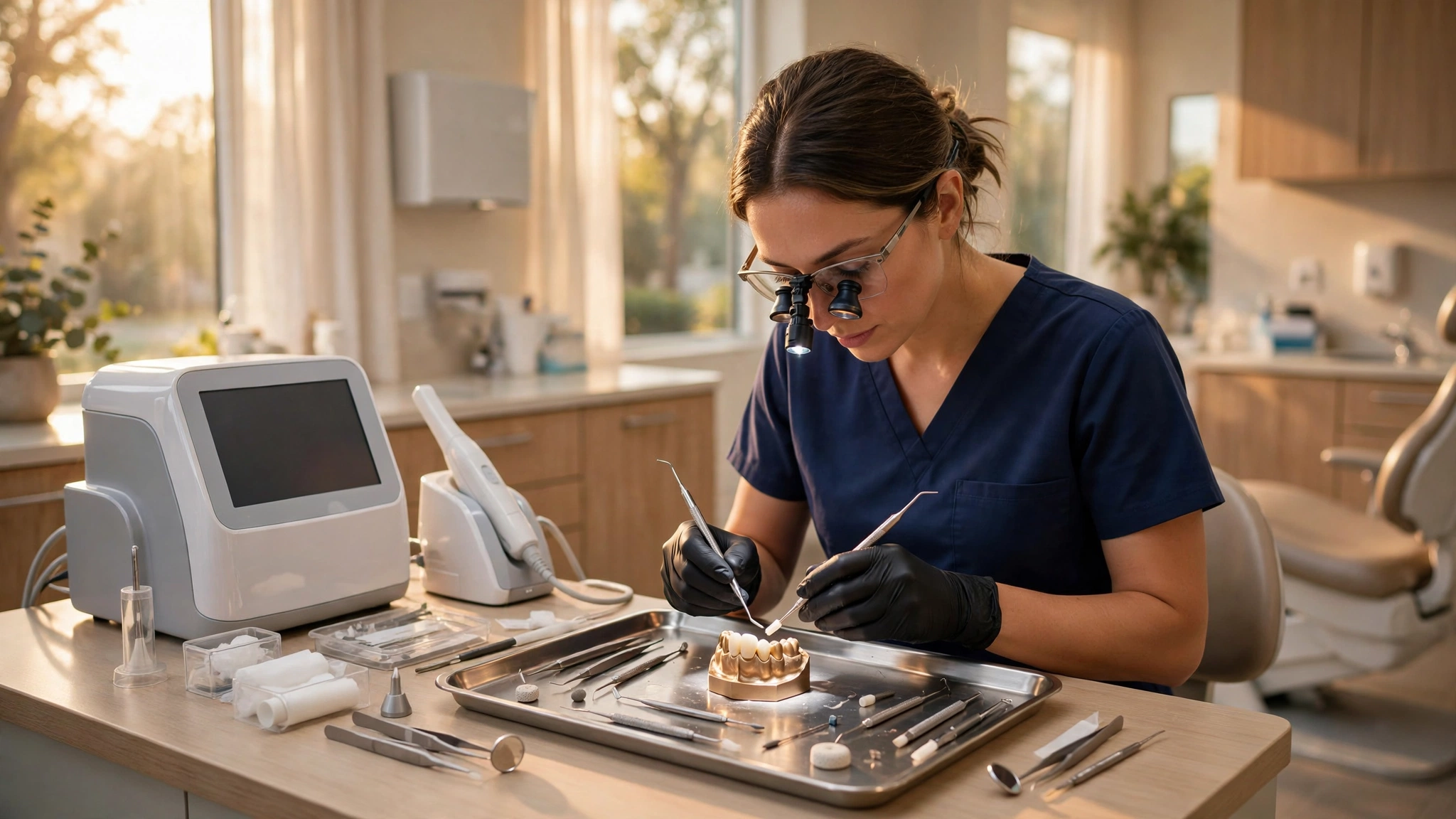
A root canal removes infected or dead tissue from inside a tooth, cleans and seals the space, and lets you keep the tooth instead of extracting it. It is done under local anaesthetic, so it should not hurt during the procedure. Most treated teeth last a long time: in one long-term study, 97% survived ten years.
Key facts
| Detail | |
|---|---|
| What it is | Removing infected pulp from inside the tooth, then sealing it |
| Does it hurt | No, with local anaesthetic. The infection hurt first |
| Visits | Usually one; sometimes two for a badly infected tooth |
| Cost at Paris Dental | $595 anterior, $995 molar |
| Crown afterwards | $1,295, usually needed on a back tooth |
| Treated tooth survival | 97% at 10 years, 68% at 37 years |
What is actually inside a tooth
A tooth is not solid. Under the hard enamel and dentine there is a chamber containing the pulp: nerves, blood vessels and connective tissue. That pulp is what gives a tooth sensation, and it is what becomes infected when decay or trauma reaches it.
From the chamber, narrow canals run down each root to the tip. A front tooth usually has one canal. A molar can have three or four, and their shapes vary enormously between people. That variation is the main reason a root canal on a molar costs more and takes longer than one on a front tooth.
Once the pulp is infected, it does not heal. The body cannot clear bacteria from a sealed space with no blood supply. That is why the treatment is removal rather than medication.
Does a root canal hurt?
This is the question everyone asks, and the honest answer is that the reputation is out of date.
The procedure is done with local anaesthetic. You should feel pressure and movement, not pain. What people remember as "root canal pain" is almost always the toothache that sent them there — an inflamed or abscessed pulp is genuinely painful, and it hurts before treatment, not during it.
Afterwards, the tissue around the root is inflamed from the infection and the procedure. Most people describe mild tenderness for two or three days, worse on biting, and manage it with ordinary pain relief. If pain is severe or increasing after a few days, that is worth a call rather than waiting.
How long does a treated tooth last?
There is good long-term data here, which is unusual in dentistry.
A study following 598 root-filled teeth in 312 patients reported cumulative survival of 97% at 10 years, 81% at 20 years, 76% at 30 years and 68% at 37 years (Ricucci et al., 2022). Endodontic success — meaning the treatment itself was working, not just that the tooth was still present — was 93%, 85%, 81% and 81% at the same points.
Two things follow. First, a root canal is not a temporary measure. Second, survival declines over decades, which is normal: teeth are lost for many reasons, and a 37-year-old root filling in a 70-year-old mouth has had a long working life.
What shortens the odds:
- No crown on a back tooth. An unrestored root-filled molar fractures. The crown is not optional.
- A poor seal. Bacteria re-entering the canal is the main cause of failure.
- Continuing gum disease, which is a separate problem but destroys the same tooth.
- Heavy grinding, which loads a tooth that no longer has its own nerve supply.
Did you know: a root canal does not kill the tooth
The tooth stays alive in every way that matters. It remains anchored in bone by its periodontal ligament, it still feels pressure when you bite, and it still responds to the forces of chewing. What it loses is the ability to feel temperature and to register decay as pain.
That ligament is the detail that matters when comparing against an implant. An implant fuses rigidly to bone. A natural tooth has a cushion that tells your brain how hard you are biting. No implant reproduces that.
Did you know: the "root canals cause illness" idea came from bad science
In the 1920s a dentist named Weston Price concluded that root-filled teeth caused systemic disease, based on experiments that would not meet any modern standard. The theory led to thousands of teeth being extracted. Reviews of the evidence since have not supported it, and the American Association of Endodontists has publicly rejected the claim.
What is true is narrower and more useful: an untreated dental infection can spread and become dangerous, and gum disease is associated with other conditions. Treating the infection is the point.
How we do it at Paris Dental
- Diagnosis. We take a radiograph and examine the tooth to confirm the pulp is involved, and to rule out a vertical root fracture — which cannot be treated this way.
- Anaesthetic. The tooth and the surrounding tissue are numbed thoroughly. This is the step that makes the rest comfortable.
- Access and clean. We open the tooth, remove the infected pulp, and clean and shape each canal to its full length.
- Seal. The canals are filled and sealed, and the opening is closed.
- Restore. A crown is planned, usually at a separate visit once the tooth has settled. On a back tooth this is what prevents fracture.
What it costs
| Treatment | Fee |
|---|---|
| Root canal, anterior tooth | $595 per tooth |
| Root canal, molar | $995 per tooth |
| Core build-up, if structure is missing | $195 per tooth |
| Crown afterwards | $1,295 per tooth |
Every fee is on our full treatment price list. A crown is charged separately because it is a separate procedure, and it is the part that determines whether the root canal lasts.
For comparison, extracting the tooth is $295 and replacing it with a complete implant is $4,085. That is the arithmetic behind keeping a tooth that can be saved.
When to call us
Ring (951) 577-8090 if you have:
- Pain that wakes you at night, or throbs with your heartbeat
- A tooth that is sensitive to heat long after the heat is gone
- Swelling in the gum, cheek or jaw
- A tooth that has darkened after an injury
Go to an emergency room rather than waiting if swelling is spreading to your eye, face or neck, or if you have difficulty breathing or swallowing. A dental infection that reaches those tissues can become life-threatening within hours.
Common questions
Does a root canal hurt? No, not during. It is done under local anaesthetic. The pain that brings you in is from the infection, and that stops once the tooth is treated. Mild tenderness for a few days afterwards is normal.
How long will the tooth last? Long-term data shows 97% of treated teeth surviving 10 years, 81% at 20 years, and 68% at 37 years. A crown on a back tooth is the single biggest factor you control.
How much does it cost? $595 for an anterior tooth and $995 for a molar at this practice. A crown is $1,295 and charged separately. Extraction and implant replacement would total more.
Is one visit enough? Usually. A severely infected tooth may need two, to place medication and let the infection settle before the final seal.
What if the tooth is cracked? If the crack runs vertically down the root, it cannot be sealed and the tooth cannot be saved. That is found at diagnosis, before treatment starts.
Can I just take antibiotics? No. Antibiotics reduce the surrounding infection but cannot sterilise a dead pulp inside a sealed tooth. The problem returns when the course finishes.
Sources
- Ricucci D, et al. Long-term tooth survival and success following primary root canal treatment: a 5- to 37-year retrospective study. International Endodontic Journal. 2022. https://pmc.ncbi.nlm.nih.gov/articles/PMC10264502/
- Patel S, Jarad F, Moawad E, Boland A. The tooth survival of non-surgical root-filled posterior teeth and the associated prognostic tooth-related factors: a systematic review and meta-analysis. International Endodontic Journal. 2024. https://pubmed.ncbi.nlm.nih.gov/38949036/
- American Association of Endodontists: root canal treatment. https://www.aae.org/patients/root-canal-treatment/
- American Dental Association: root canal explained. https://www.ada.org/resources/ada-library/oral-health-topics/root-canals
Results vary between patients. This article is general information and is not a substitute for an examination.
Book an assessment
If a tooth is painful or you have been told it needs a root canal, call (951) 577-8090 or request a visit. We are open Monday to Friday, 10:00 am to 5:00 pm.
For the wider decision, read root canal or extraction or see restorative dentistry at Paris Dental.
Common questions
Does a root canal hurt?
The procedure is done under local anaesthetic, so it should not hurt while it is happening. The pain people associate with root canals usually comes from the infection beforehand, not the treatment. Most patients report mild tenderness for a few days afterwards, managed with over-the-counter pain relief.
How long does a root canal last?
A large long-term study followed 598 root-filled teeth and found 97% survived 10 years, 81% survived 20 years, 76% survived 30 years and 68% survived 37 years. What determines that is the quality of the seal, whether a crown protects the tooth afterwards, and your gum health.
How much does a root canal cost in Temecula?
At Paris Dental a root canal is $595 for an anterior tooth and $995 for a molar, because molars have more canals. A crown afterwards is $1,295 and is usually recommended on a back tooth. You receive a written estimate before treatment begins.
How many visits does it take?
Many root canals are completed in one visit. A badly infected tooth, or one with complex anatomy, may need a second appointment to finish cleaning and sealing the canals.
Can the tooth be saved?
Usually, if the tooth is not cracked through the root and there is enough structure left to hold a crown. A vertical root fracture cannot be sealed, and extraction is the honest answer in that case.
What happens if I do not treat it?
The infection continues. It can spread into the bone and the soft tissues of the face, which becomes a medical emergency. A dental infection does not resolve on its own.
Is it better to just pull the tooth?
Not if it can be predictably sealed and restored. Keeping the natural tooth preserves the ligament that cushions it and avoids the cost of an implant, which is $4,085 for a complete tooth at this practice. A tooth with a vertical root fracture or too little structure is the exception.