



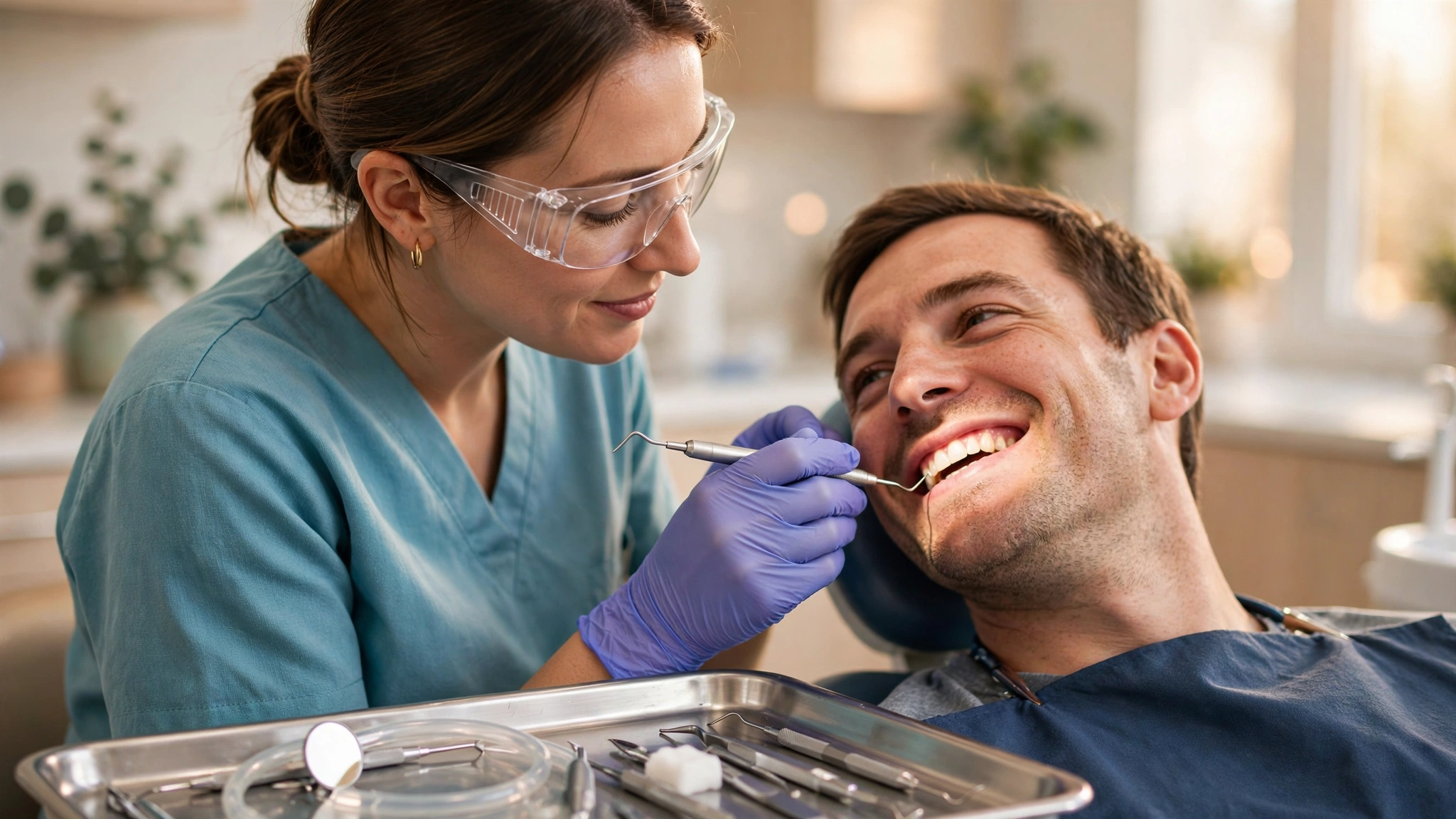
Plaque is a soft film of bacteria you can remove yourself, every day, with a brush and something between the teeth. Tartar is plaque that has mineralised onto the tooth and bonded to it, and no toothbrush, paste or home remedy will take it off — it has to be scaled by a dental professional. Scrubbing at it with abrasives wears enamel instead.
Key facts
| Detail | |
|---|---|
| Plaque | Soft bacterial film, removable at home, forms within hours |
| Tartar (calculus) | Mineralised plaque, bonded to the tooth, cannot be removed at home |
| Time to harden | Roughly 24 to 72 hours if not disturbed |
| What removes plaque | Daily mechanical cleaning: brush plus interdental cleaning |
| What removes tartar | Professional scaling only |
| Cleaning at Paris Dental | $205 routine, $195 per quadrant if deep cleaning is needed |
The difference that matters
These two words get used interchangeably and they are not the same problem.
Plaque is a biofilm. It forms continuously on every tooth surface, it is soft, and it can be brushed and flossed away. If you run a fingernail along a tooth after not brushing for a day, that film is plaque.
Tartar, or calculus, is what plaque becomes when minerals in saliva bind into it. It sets hard against the tooth, most often where the salivary ducts are — the inside of the lower front teeth and the outside of the upper molars. It is porous, so it holds bacterial deposits against the gum line and makes daily cleaning less effective.
The distinction decides who can fix it. Plaque removal is a home task. Tartar removal is a clinical one.
Why home remedies for tartar do not work
Search "how to remove tartar" and you will find bicarbonate, vinegar, lemon, charcoal and abrasive pastes. None of them remove bonded calculus, and several cause harm.
- Abrasive pastes and charcoal slowly wear enamel. Enamel does not regenerate. Worn enamel exposes dentine, which is yellower and more sensitive — so the cosmetic outcome is the opposite of the intent.
- Acid (vinegar, lemon) softens enamel temporarily. Repeated use erodes it.
- Scraping with metal implements risks cutting the gum and scratching the root surface, which makes it easier for plaque to collect.
What these methods can do is remove surface stain, which is a different thing from calculus and is easily confused with it in a mirror.
What actually works, in order
1. Brush twice a day with fluoride toothpaste. Two minutes is a reasonable target and most people brush for far less. Do not rinse straight after — spit, don't rinse, so the fluoride stays on the tooth.
2. Clean between the teeth once a day. This is the part most people skip and the part that matters most for gum disease, because that is where the pockets form. Floss or interdental brushes; a toothbrush alone does not reach those surfaces.
3. Do not let plaque sit. Plaque begins to mineralise within about 24 to 72 hours. Once-daily interdental cleaning is frequent enough to disrupt it before it sets.
4. Get the tartar removed professionally. Once it has formed, this is the only route, and it is a quick appointment rather than a procedure to dread.
Did you know: calculus is the reason gum disease is measured by numbers, not looks
Because tartar is porous, it holds bacterial deposits directly against the gum, and the gum responds by becoming inflamed. That inflammation is what destroys the attachment between gum and tooth over years. It is why a dentist measures pocket depth with a probe around every tooth rather than judging by appearance: the damage is happening under the surface, and it does not hurt in the early stages.
Gum disease is one of the most common chronic conditions in adults and one of the most undertreated, precisely because it is quiet. Bleeding gums are the earliest visible sign and they are not normal.
Did you know: a dental cleaning does not whiten teeth
A scale and polish removes stain and calculus from the outside. That can make teeth look noticeably brighter, because the film that was dulling them is gone. But the colour of the tooth itself has not changed.
Whitening is a different treatment with a different mechanism. If what you want is a shade change, ask about whitening rather than expecting a cleaning to deliver it.
How we do it at Paris Dental
- Examination first. We check the gums, measure pocket depths and look for decay before scaling. A cleaning is not a substitute for an examination.
- Scaling. Tartar is removed from above the gum line with hand instruments and an ultrasonic scaler.
- Polishing. The surfaces are polished to make them smoother, which slows plaque re-attachment.
- Advice specific to your mouth. Which interdental tool suits your gaps, and how to use it — this is the part that changes outcomes.
- A review interval based on your measurements, not a fixed six months for everyone.
If the pockets are deep enough that a routine clean will not reach the deposits, we will say so and explain deep cleaning instead.
What it costs
| Treatment | Fee |
|---|---|
| Routine cleaning (prophylaxis) | $205 per visit |
| Deep cleaning, if gum disease is present | $195 per quadrant |
| Periodontal maintenance | $295 per visit |
| New-patient examination with radiographs | $195 per visit |
Every fee is on our full treatment price list. A routine cleaning and a deep cleaning are different procedures at different prices, and the difference is decided by measurement, not preference.
When to call rather than wait
Book an examination if your gums bleed most days, if they look red or swollen, if your breath is persistently unpleasant despite cleaning, or if any tooth feels loose or has started to shift.
See someone urgently if you have facial swelling, difficulty swallowing, or a fever with dental pain. Those are signs of spreading infection, not gum inflammation.
Common questions
Can I remove tartar myself? No. It is bonded to the tooth and has to be scaled off clinically. Home abrasives wear enamel without removing it.
Where does tartar build up most? Behind the lower front teeth and on the outside of the upper back teeth, because that is where the salivary ducts are. Those are the areas to check in a mirror.
Is a cleaning painful? A routine scale and polish is usually comfortable, with some sensitivity around the gum line. Deep cleaning is done under local anaesthetic.
Does mouthwash remove plaque? It reduces some bacteria but does not disrupt the biofilm mechanically. It is an addition to brushing and interdental cleaning, not a replacement.
Why do my gums bleed when I floss? Because they are inflamed. Bleeding usually settles within one to two weeks of consistent cleaning. Stopping because it bleeds makes the inflammation worse.
Sources
- Kamath DG, Nayak SU. Detection, removal and prevention of calculus: literature review. The Saudi Dental Journal. 2013. https://pmc.ncbi.nlm.nih.gov/articles/PMC3923169/
- American Dental Association: home oral care. https://www.ada.org/resources/ada-library/oral-health-topics/home-oral-care
- American Dental Association: gum disease. https://www.ada.org/resources/ada-library/oral-health-topics/gum-disease
- Centers for Disease Control and Prevention: periodontal disease surveillance. https://stacks.cdc.gov/view/cdc/31519/cdc_31519_DS1.pdf
Results vary between patients. This article is general information and is not a substitute for an examination.
Book a cleaning
Call (951) 577-8090 or request a visit. We are open Monday to Friday, 10:00 am to 5:00 pm.
See cleanings and examinations at Paris Dental for what a visit includes, or read about gum disease treatment if your gums bleed.
Common questions
Can you remove tartar at home?
No. Tartar is plaque that has mineralised onto the tooth surface and it bonds too tightly to be brushed or scraped off safely. It has to be scaled by a dental professional. Home remedies such as bicarbonate, vinegar or abrasive pastes do not remove it and can wear away enamel, which does not grow back.
How fast does plaque turn into tartar?
Plaque begins to mineralise within about 24 to 72 hours if it is not disturbed, which is why cleaning between the teeth every day matters. Once it has hardened it cannot be brushed away, and it continues to build in layers.
Is tartar harmful on its own?
Tartar is porous, so it holds bacterial deposits against the gum line and makes plaque harder to remove. That is what drives gum inflammation. It is not the tartar itself that destroys bone, but the plaque it shelters and the gum response to it.
What actually removes plaque?
Mechanical disruption, done daily. A toothbrush reaches the flat surfaces; interdental brushes or floss reach between the teeth, which is where gum disease starts. Mouthwash is an adjunct, not a replacement, and rinsing straight after brushing washes away the fluoride.
How often should I have a cleaning?
It depends on your gums rather than a fixed rule. Someone with healthy gums and no history of decay may need less frequent scaling than someone with treated periodontitis, who is usually seen on a maintenance schedule. Ask for an interval based on your own measurements.
Does a cleaning whiten teeth?
A scale and polish removes surface stain and tartar, which can make teeth look brighter, but it does not change the intrinsic colour of the tooth. That is what whitening does, and it is a different treatment.