



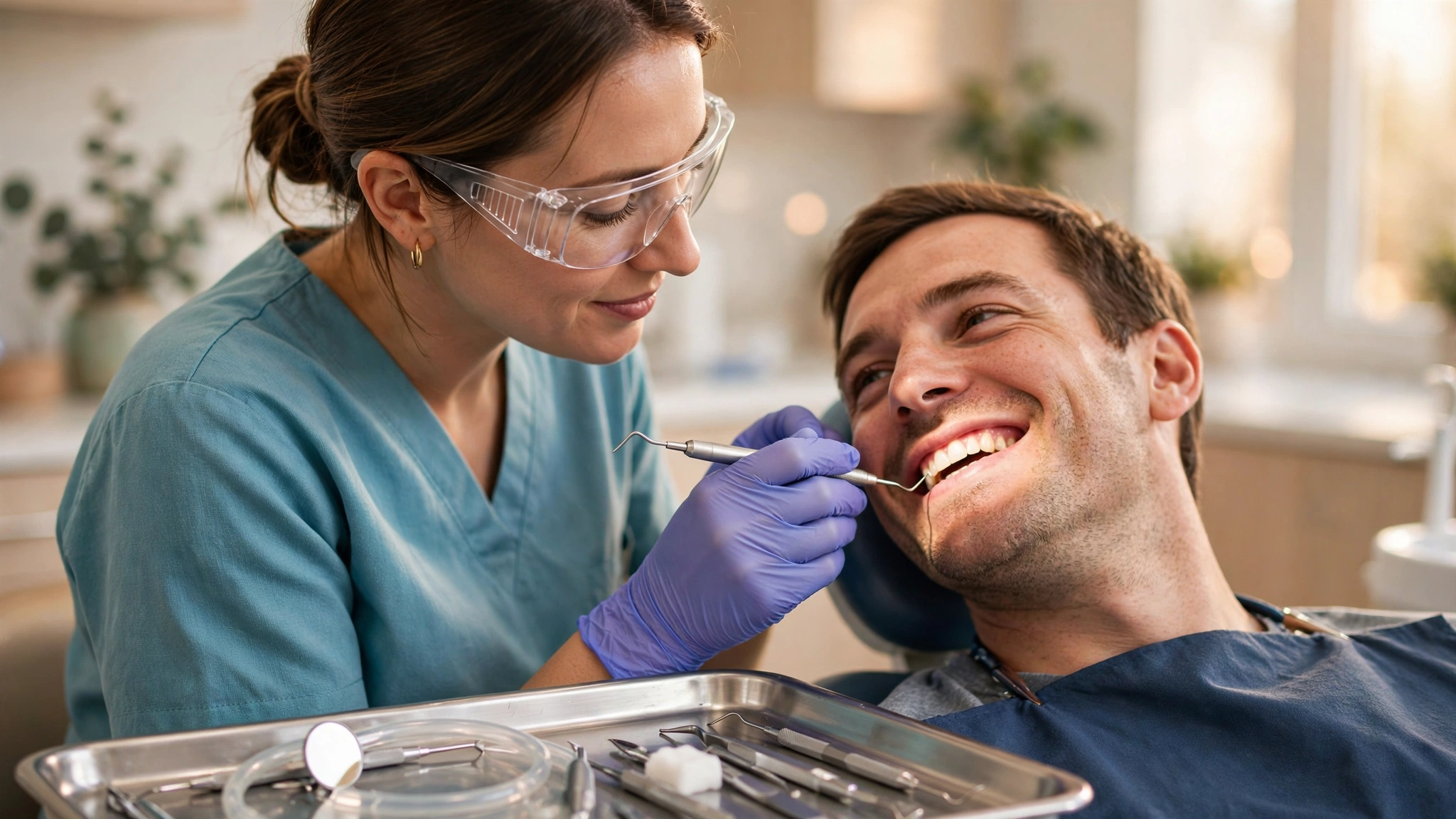
Dental care is safe at every stage of pregnancy, including radiographs, local anaesthetic and extractions. Nothing about being pregnant requires you to postpone a cleaning or to sit through a toothache until after delivery.
The ADA and the American College of Obstetricians and Gynecologists agree on this, and have for years. What pregnancy does change is the risk of gum inflammation, the effect of vomiting on enamel, and the list of medicines that need a second look. Those are worth planning for.
Key facts
| Detail | |
|---|---|
| Is dental treatment safe in pregnancy | Yes, at any stage, per the ADA |
| Radiographs in pregnancy | Safe at any stage; shielding no longer recommended |
| Local anaesthetic | Safe; lidocaine, mepivacaine and bupivacaine all listed |
| Gingivitis at 3 months of pregnancy | 88% of 220 women in one study, 73% of cases severe |
| When pregnancy gingivitis peaks | Between the second and eighth month |
| Nitrous oxide | ADA Category C; pregnant patients should avoid it |
| The calcium myth | False; the fetus does not take calcium from the mother's teeth |
Is dental treatment safe during pregnancy?
Yes. This is the single most useful fact in the topic, because the opposite belief is widespread and it keeps people away from care they need.
The American Dental Association's pregnancy topic, last updated in 2025, states that "oral health care, including having dental radiographs taken and being given local anesthesia, is safe at any point during pregnancy." It goes further: the ADA and ACOG agree that emergency treatment such as extractions, root canals and restorations can be performed safely during pregnancy, and that delaying treatment may result in more complex problems.
That last clause matters. A tooth that would have been a filling in the second trimester can become an abscess needing extraction by the third. Delay is not a neutral choice.
Radiographs. The ADA states they are "safe for the pregnant patient, at any stage during pregnancy," and adds that abdominal or thyroid shielding is no longer recommended. The beam is collimated to the mouth and the dose is very low.
Local anaesthetic. The ADA lists local anaesthetics with epinephrine, naming bupivacaine, lidocaine and mepivacaine, among the options considered safe. Epinephrine is included in that list, which is worth noting because it is a common worry.
Medicines. The ADA lists penicillin, amoxicillin, cephalosporins, clindamycin and metronidazole as antibiotics considered safe in this situation. For pain relief it is more cautious, because the FDA stated in 2015 that published research is "too limited to make any recommendations" on pain relievers in pregnancy. That is a conversation with your obstetrician rather than a decision to make alone.
Nitrous oxide. Here the guidance points the other way. The ADA classifies nitrous oxide as pregnancy risk Category C and recommends that pregnant patients avoid exposure. If a procedure needs sedation, plan it rather than assume it.
Why do gums change in pregnancy?
Hormones raise blood flow to the gum tissue and make it react more strongly to plaque. The ADA describes pregnancy gingivitis as resulting from "hormonal changes that exaggerate the response to bacteria in the gum tissue," and its patient information on female hormones notes that this form of gingivitis is most common between the second and eighth month of pregnancy.
The scale of it is larger than most people expect. A 2023 multicentre cross-sectional study by Gare and colleagues in Journal of Clinical Medicine examined 220 women at three months of pregnancy in Dakar, Senegal. 88% had gingivitis, with 15% moderate and 73% severe. Two thirds of the sites bled on interdental brushing.
That is one population in one setting, so the percentage should not be read as universal. But the direction holds, and a 2022 systematic review and meta-analysis by Chen and colleagues in the Journal of Dentistry pooled 20 studies and put the prevalence of periodontitis in pregnancy at 40% (95% CI 0.15 to 1.00). The same review found bleeding on probing at 67%, pocket depth of 4 mm or more at 42%, and clinical attachment loss of 4 mm or more at 24%, with attachment loss highest in the second trimester. The authors noted high heterogeneity.
The practical translation: bleeding gums in pregnancy are common, expected, and still worth treating. Common is not the same as harmless.
What happens to the teeth?
Three mechanisms do the damage, and none of them involves the fetus taking minerals from your teeth.
Vomiting and reflux. Stomach acid reaches the mouth and dissolves mineral at the enamel surface. The tooth erosion article sets out the mechanism. The ADA gives specific advice for morning sickness: do not brush immediately after vomiting, because brushing abrades softened enamel. Instead rinse with a diluted solution of one cup of water and one teaspoon of baking soda to neutralise the acid, and brush later.
Changed diet and snacking. Cravings usually mean more frequent sugar exposure, and frequency matters more than quantity for decay. The ADA lists increased snacking, increased acidity from vomiting, dry mouth and poorer hygiene from nausea as the reasons caries risk rises.
Nausea making brushing difficult. This is underrated. If brushing the back teeth triggers gagging, those teeth get missed for months. A smaller brush head, a milder toothpaste and brushing at a different time of day all help.
Pregnancy granuloma. The ADA describes pyogenic granuloma, also called granuloma gravidarum, as a round growth usually attached to the gum by a thin cord of tissue, developing because of hormonal changes. It is not cancer and it often shrinks after delivery, but it can bleed and it can interfere with eating. It is worth having examined rather than removed in a hurry.
Does gum disease affect the pregnancy?
This is where the evidence gets interesting, and where honesty matters more than a tidy answer.
The ADA's summary reports that an overview of 23 systematic reviews conducted through 2016 concluded that associations exist between periodontitis and preterm birth, low birthweight babies, low birthweight babies born prematurely, and the development of pre-eclampsia.
A 2022 systematic review and meta-analysis by Le and colleagues in Maternal and Child Health Journal pooled 30 studies and found periodontitis significantly associated with pre-eclampsia, with an odds ratio of 3.18 (95% CI 2.26 to 4.48). In the cohort subgroup the odds ratio was 4.19 (95% CI 2.23 to 7.87).
So the association is consistent and reasonably strong. The question that follows is whether treating the gums changes the outcome, and there the answer is less satisfying.
A 2025 systematic review and meta-analysis by Xu and colleagues in the Journal of Maternal-Fetal and Neonatal Medicine pooled 13 randomised controlled trials. Periodontal treatment showed a possible effect on preventing pregnancy gingivitis, but it was not statistically significant (OR 0.85, 95% CI 0.68 to 1.06). Subgroup analysis found significant reductions in preterm birth and low birth weight only in the lower-quality studies, with no significant effect in the higher-quality ones.
The ADA's own wording captures the position precisely. Quoting ACOG: "despite the lack of evidence for a causal relationship between periodontal disease and adverse pregnancy outcomes, the treatment of maternal periodontal disease during pregnancy is not associated with any adverse maternal or birth outcomes," and "prenatal periodontal therapy is associated with the improvement of maternal oral health."
That is the honest summary. Treat the gums because the gums need treating, and because it is safe, not because it is a proven way to prevent a preterm birth.
What about the calcium myth?
A 2023 systematic review by Kamalabadi and colleagues in BMC Oral Health examined unfavourable beliefs about oral health in pregnancy across 39 quantitative and six qualitative studies. Three beliefs dominated:
- "Pregnant women lose their teeth because of pregnancy" — appeared in 18 studies
- "Dental treatments are not safe and harm the fetus" — 17 studies
- "The developing baby absorbs calcium from the mother's teeth" — 14 studies
All three are false, and all three lead to the same behaviour: avoiding the dentist.
Enamel is formed before the tooth erupts and has no living cells afterwards. It cannot donate mineral to a fetus, because there is no blood supply to it and no mechanism to move mineral out. The article on what teeth are made of explains the tissue structure. Dietary calcium for the baby comes from the mother's diet and her skeleton, not from her teeth.
The belief is worth naming because it is so widely held, and because someone who holds it will skip a cleaning that would have prevented the problem they fear.
What should you do in each trimester?
The trimesters are a practical planning tool rather than a set of hard rules. Treatment is safe throughout, and the ADA says so plainly. What changes is comfort and convenience. A 2013 review by Steinberg and colleagues in Dental Clinics of North America records the reason this is worth stating repeatedly: women tend to receive less dental care than usual when they are pregnant, and the first national consensus statement on oral health care during pregnancy, issued in 2012, existed precisely to counter that.
First trimester. Get the examination and the cleaning done, and deal with anything urgent. Nausea is often at its worst here, so a morning appointment with a light meal beforehand helps. Tell the dentist you are pregnant at the first visit, before any radiograph or prescription. The MouthHealthy pregnancy page is the ADA's own starting point for patients at this stage.
Second trimester. This is the most comfortable window for elective work, and the ADA notes that more frequent cleanings may be recommended here and in the early third trimester to control gingivitis. If a crown, a filling or a periodontal deep cleaning has been deferred, this is the time to schedule it.
Third trimester. Lying flat for a long appointment becomes difficult as the uterus presses on the vena cava, so shorter visits and a slight incline help. Anything elective that can wait a few weeks usually should, not because it is unsafe but because it is easier.
After delivery. Keep the appointment. The hormonal changes settle, but the habits and the gum inflammation do not always settle with them.
How we approach it at Paris Dental
We ask about pregnancy at the first visit and we ask again at subsequent ones, because a patient who was not pregnant at the last check-up may be now. That question changes the radiograph plan, the medicine list and the interval between cleanings.
The examination looks at the gum response specifically. Bleeding on probing, the colour and contour of the margins, and any localized growth are recorded, because pregnancy gingivitis is a pattern to track rather than a single finding to note.
Radiographs are taken when there is a clinical question that needs answering. That is the same standard as for any other patient; pregnancy does not change it in either direction, and the ADA's position is that they are safe if needed.
For morning sickness we give the specific instruction rather than general advice: do not brush straight after vomiting, rinse with water and baking soda, brush later. Patients who have been told only to "keep brushing" often do exactly the wrong thing at exactly the wrong moment.
Where a procedure needs sedation, we plan it rather than default to it, because nitrous oxide is the one item on the list that the guidance says to avoid.
And where the gums are involved beyond a simple gingivitis, we set out what the evidence does and does not show. Patients deserve to know that treating gum disease is safe and worthwhile without being told it will prevent a preterm birth.
What does an evaluation cost in Temecula?
Every fee below is from the practice's published price list. Nothing here is a quote for your case.
| Treatment | Fee | Unit |
|---|---|---|
| New-patient examination | $195 | per visit |
| Consultation and treatment plan | $195 | per visit |
| Routine cleaning (prophylaxis) | $205 | per visit |
| Fluoride treatment | $45 | per visit |
| Intraoral radiograph | $25 | per film |
| Deep cleaning | $195 | per quadrant |
| Periodontal maintenance | $295 | per visit |
Most pregnant patients start with an examination at $195, which includes radiographs and a written plan, and a routine cleaning at $205. Where the gums need more than a routine cleaning, the deep cleaning cost page sets out the per-quadrant fee.
Results vary between patients. How much the gums improve depends on how much plaque is removed daily, how the hormones of that particular pregnancy affect the tissue, and whether the cleaning interval is kept.
When to call us
Call (951) 577-8090 if you have:
- Gums that bleed every time you brush, or that have become swollen and tender
- A growth on the gum that bleeds or interferes with eating
- Tooth pain, or a tooth that is sensitive to heat or pressure
- A broken tooth, a lost filling or a loose crown
- Vomiting often enough that the teeth feel rough or sensitive
- Dry mouth that has persisted for more than two weeks
- Any question about whether a treatment can wait, which is a question worth asking rather than guessing
Go to an emergency room or call 911 if you have facial swelling with fever, swelling that is spreading toward the eye or neck, or difficulty swallowing or breathing. Those need immediate care and should never wait for a dental appointment.
If you have a high-risk pregnancy, tell us at booking. It does not mean dental care is unsafe; it means the plan should be made with your obstetrician informed.
Common questions
Should I postpone my cleaning until after the baby is born? No. The ADA's position is that preventive treatment is safe throughout pregnancy, and the second trimester is the most comfortable time for it. Postponing means months without plaque removal at the point when the gums react most strongly to plaque.
Can I have a filling while pregnant? Yes. The ADA lists restorative treatment among the procedures that are safe, and it lists local anaesthetics with epinephrine among the options considered safe. An untreated cavity does not pause during pregnancy; it continues to enlarge.
Is it safe to have a tooth extracted? The ADA names extractions explicitly among the emergency treatments that can be performed safely, and warns that delay can create more complex problems. A tooth that needs to come out is better out than abscessed.
What about antibiotics? The ADA lists penicillin, amoxicillin, cephalosporins, clindamycin and metronidazole as options considered safe in pregnancy. Any antibiotic still needs to be appropriate for the infection being treated, and the prescriber should know you are pregnant.
Can I whiten my teeth while pregnant? The at-home whitening article addresses this directly. There is no good evidence of harm from peroxide whitening in pregnancy and no good evidence of safety, so most practitioners defer it. It is elective, which makes deferring easy.
Does pregnancy cause tooth loss? No, and this is the belief the evidence most clearly contradicts. Tooth loss follows untreated decay and untreated gum disease, both of which are more likely when dental visits stop. A 2023 systematic review found the belief held widely enough to appear in 18 of 45 studies. The causation runs through avoidable disease, not through pregnancy itself.
Is dental X-ray radiation a risk to the baby? The ADA states radiographs are safe at any stage of pregnancy and that shielding is no longer recommended. A dental radiograph is a small, tightly collimated dose to the mouth, not to the abdomen. If you would still rather limit them, say so, and the dentist can decide which images are essential and which can wait.
When should I first take my baby to the dentist? The first dental visit article covers the timing. In short, by the first birthday or within six months of the first tooth, whichever comes first.
Sources
- American Dental Association. Pregnancy. Oral Health Topics, ADA Library and Archives. Last updated July 14, 2025. https://www.ada.org/resources/ada-library/oral-health-topics/pregnancy
- American Dental Association. Female hormones and dental health. MouthHealthy. https://www.mouthhealthy.org/all-topics-a-z/female-hormones-and-dental-health
- American Dental Association. Dental health during pregnancy. MouthHealthy. https://www.mouthhealthy.org/life-stages/pregnancy
- Gare J, Kanoute A, Orsini G, Gonçalves LS, Ali Alshehri F, Bourgeois D, Carrouel F. Prevalence, severity of extension, and risk factors of gingivitis in a 3-month pregnant population: a multicenter cross-sectional study. Journal of Clinical Medicine. 2023;12(9):3349. https://pubmed.ncbi.nlm.nih.gov/37176789/
- Chen P, Hong F, Yu X. Prevalence of periodontal disease in pregnancy: a systematic review and meta-analysis. Journal of Dentistry. 2022;125:104253. https://pubmed.ncbi.nlm.nih.gov/35998741/
- Le QA, Akhter R, Coulton KM, Vo NTN, Duong LTY, Nong HV, Yaacoub A, Condous G, Eberhard J, Nanan R. Periodontitis and preeclampsia in pregnancy: a systematic review and meta-analysis. Maternal and Child Health Journal. 2022;26(12):2419-2443. https://pubmed.ncbi.nlm.nih.gov/36209308/
- Xu H, Cai M, Xu H, Shen XJ, Liu J. Role of periodontal treatment in pregnancy gingivitis and adverse outcomes: a systematic review and meta-analysis. Journal of Maternal-Fetal and Neonatal Medicine. 2025;38(1):2416595. https://pubmed.ncbi.nlm.nih.gov/39721768/
- Kamalabadi YM, Campbell MK, Zitoun NM, Jessani A. Unfavourable beliefs about oral health and safety of dental care during pregnancy: a systematic review. BMC Oral Health. 2023;23(1):762. https://pubmed.ncbi.nlm.nih.gov/37840149/
- Steinberg BJ, Hilton IV, Iida H, Samelson R. Oral health and dental care during pregnancy. Dental Clinics of North America. 2013;57(2):195-210. https://pubmed.ncbi.nlm.nih.gov/23570802/
Results vary between patients. This article is general information and is not a substitute for an individual examination.
Book an examination
Pregnancy is a reason to keep a dental appointment, not to cancel one. If you are pregnant and have not had a check-up in the last six months, or if your gums have started bleeding, an examination will show what needs doing now and what can wait. Call (951) 577-8090 or request a visit. We are at 31285 Temecula Pkwy Ste 205, Temecula, CA 92592, open Monday to Friday, 10:00 am to 5:00 pm. An online request is not a confirmed appointment.
If your gums are the main concern, read when bleeding gums need a dentist and what gum disease does to the gum line, or the periodontal service page. If vomiting has left your teeth sensitive or rough, the enamel erosion article explains what can and cannot be reversed. Once the baby arrives, the first dental visit guide covers the next milestone.
Common questions
Is it safe to go to the dentist while pregnant?
Yes. The American Dental Association states that preventive, diagnostic, restorative and surgical dental treatment is safe throughout pregnancy, and that radiographs and local anaesthetic may be used at any stage. The ADA and the American College of Obstetricians and Gynecologists agree that emergency treatment such as extractions, root canals and fillings can be performed safely, and that delaying it can lead to more complex problems. Routine care is not something to postpone until after delivery.
Why do my gums bleed more in pregnancy?
Hormonal changes raise the blood flow to the gum tissue and exaggerate its response to plaque. The ADA describes pregnancy gingivitis as resulting from hormonal changes that exaggerate the response to bacteria in the gum tissue. A 2023 study of 220 women at three months of pregnancy found 88% had gingivitis, with 73% of those classified as severe. It is common, it is measurable, and it responds to plaque removal.
Can I have a radiograph during pregnancy?
Yes. The ADA states that radiographs are considered safe for the pregnant patient at any stage of pregnancy, and notes that abdominal and thyroid shielding is no longer recommended. The dose from a dental radiograph is very low and the beam is collimated to the mouth. If you are concerned, say so at the appointment so the reason for each image can be explained before it is taken.
Can I have a local anaesthetic while pregnant?
Yes. The ADA lists local anaesthetics with epinephrine, including lidocaine, mepivacaine and bupivacaine, as options considered safe for pregnant patients. Untreated pain carries its own risks, including poor nutrition and sleep, and an untreated infection can spread. Tell the dentist you are pregnant so the choice of anaesthetic and any pain relief can be planned with that in mind.
Is nitrous oxide safe in pregnancy?
The ADA classifies nitrous oxide as a pregnancy risk Category C medication, meaning there is a risk of fetal harm with exposure, and recommends that pregnant patients avoid exposure to it. That makes it a treatment to leave out rather than a routine option. If you need sedation for a procedure, the alternative is a planned discussion rather than a default.
What is pregnancy gingivitis?
It is gum inflammation caused by the exaggerated response to plaque during pregnancy. It usually appears between the second and eighth month, according to the ADA's patient information. The gums look red, tender and swollen, and they bleed when brushed. The treatment is the same as for ordinary gingivitis, done more carefully: thorough plaque removal, flossing and professional cleaning, often at a shorter interval during the second trimester.
Can dental problems affect the baby?
The association is real but the causal link is not established. The ADA reports that an overview of 23 systematic reviews found associations between periodontitis and preterm birth, low birthweight, low birthweight born prematurely, and pre-eclampsia. A 2022 meta-analysis of 30 studies found periodontitis associated with pre-eclampsia at an odds ratio of 3.18. What the evidence does not show is that treating gum disease prevents those outcomes, and the ADA is clear that treating it is nevertheless safe and improves the mother's oral health.
Do babies take calcium from their mother's teeth?
No. This is one of the most common beliefs in pregnancy and it is false. A 2023 systematic review of 45 studies found it was held widely enough to be one of the three most discussed unfavourable beliefs, appearing in 14 studies, alongside the belief that pregnancy causes tooth loss and that dental treatment harms the fetus. The enamel of an adult tooth is already formed and does not give up its mineral to a developing baby. Tooth damage in pregnancy comes from plaque, acid and changes in diet and hygiene, not from the fetus drawing calcium out of the teeth.