



Gum disease and diabetes make each other worse, and the effect is measurable in both directions. People with periodontitis were 1.26 times more likely to develop diabetes, and people with diabetes were 1.24 times more likely to develop periodontitis. Treating the gums lowered HbA1c by 0.43 points in a Cochrane review of 35 trials.
That last number is the one that matters most, because it is the only part you can act on this month.
Key facts
| Detail | |
|---|---|
| Gum disease to diabetes | Summary relative risk 1.26 (95% CI 1.12 to 1.41) |
| Diabetes to gum disease | Summary relative risk 1.24 (95% CI 1.13 to 1.37) |
| Effect of treatment on HbA1c | −0.43 points at 3 to 4 months, moderate certainty |
| Evidence base | 35 randomised trials, 3,249 participants (Cochrane 2022) |
| Periodontitis in US adults | 47.2%, or 64.7 million people |
| With neuropathy or retinopathy | 1.51 times the odds of moderate to severe periodontitis |
| What it is not | Not a treatment for diabetes, and not a replacement for medical care |
Which way does the link run?
Both ways, and that is not a slogan. It is the finding of a meta-analysis built to test direction.
Fifteen cohort studies followed people forward in time, which is the only design that can speak to which came first. Comparing people with periodontitis to people without it, the summary relative risk for developing diabetes was 1.26, across 427,620 participants (Stöhr et al., 2021). Running the other direction, people with diabetes had a summary relative risk of 1.24 for developing periodontitis, across 295,804 participants.
Both intervals sit above 1.0, so neither result is a chance finding. Neither is enormous either. A relative risk of about 1.25 is a real signal, not a dominant cause, and it is worth being precise about that because dental marketing tends to inflate it.
How much does treating gums actually change blood sugar?
By about 0.43 percentage points on HbA1c, according to the strongest review available.
The 2022 Cochrane review pooled 35 randomised trials and 3,249 participants, comparing periodontal treatment against no treatment or usual care (Simpson et al., 2022). At three to four months, HbA1c fell by an absolute 0.43% (4.7 mmol/mol), with a confidence interval of −0.59 to −0.28. At six months the fall was 0.30%, and at twelve months one trial of 264 people reported 0.50%.
The authors graded this moderate certainty, and said further trials were unlikely to change the conclusion. That is unusually strong language for a dental intervention, and it is the reason this article exists.
Did you know? The evidence grade is "moderate certainty", which this review upgraded. The 2022 update doubled the number of included trials, and its authors changed their earlier conclusion because of it. They added that further trials are unlikely to change it. (Simpson et al., 2022)
Why does high blood sugar damage gums?
Because it changes saliva, healing and the immune response at the same time.
NIDCR sets out the mechanism plainly: people with diabetes have a higher chance of periodontal disease, and diabetes can also slow healing, which interferes with treatment of that disease (NIDCR). It also raises glucose in saliva, which feeds the bacteria that form plaque, and it reduces saliva flow, which normally washes food and bacteria away.
NIDDK adds the consequence: high blood glucose increases the risk that gum disease will progress from mild to severe, and untreated it advances from inflamed gums to tooth loss (NIDDK). It also reports that almost 25% of US adults with diabetes aged 50 and older have severe tooth loss, against about 16% of those without diabetes.
Does poor control show up in the mouth before anywhere else?
It can, and the mouth is easy to look at.
One NHANES analysis of 7,042 adults found that mean glycohemoglobin was 5.9% in people with periodontitis against 5.6% without, rising to 7.4% and 7.0% among those with diabetes (Garcia et al., 2015). In the adjusted model, glycohemoglobin itself remained significantly associated with periodontitis, while self-reported diabetes status did not.
That second finding is the useful one. What tracked with gum disease was the measured number, not whether the person said they had diabetes. Someone whose control has slipped can have the mouth findings without a recent diagnosis.
Is gum disease one of the diabetes complications?
It behaves like one. A Danish study of 15,922 people with type 2 diabetes tested whether periodontitis clusters with the recognised microvascular complications.
Diabetic neuropathy was associated with moderate to severe periodontitis at an odds ratio of 1.36, and retinopathy at 1.21. Having both raised the odds 1.51 times (Bitencourt et al., 2024). A separate NHANES analysis of 2,429 people with diabetes found periodontitis clustering with cardiovascular disease, proteinuria and hypertension into a single construct, and suggested periodontal breakdown could serve as a screening marker for the others (Bitencourt et al., 2023).
Association is not cause here. What it means practically is that if your gums are breaking down, the rest of the picture deserves a look, and the reverse is also true.
How common is gum disease generally?
Common enough that it should be treated as a normal thing to check rather than a rare diagnosis. Over 47% of US adults aged 30 and older had periodontitis in the NHANES 2009–2010 cycle, representing 64.7 million people, with 8.5% in the severe category (Eke et al., 2012). Among adults 65 and older, 64% had moderate or severe periodontitis.
An earlier review reached the same direction with a different number. Nine randomised trials showed scaling and root planing reduced HbA1c by 0.56 points and C-reactive protein by 1.89 (Baeza et al., 2020). A Bayesian network meta-analysis of 14 trials also found scaling and root planing alone improved HbA1c, with the largest effect when photodynamic therapy and doxycycline were added (Cao et al., 2019).
The effect sizes differ between reviews, and the more recent and larger the review, the more conservative the estimate. The direction does not change.
What this means for your care
Three practical things follow, and none of them is "buy a special toothpaste".
Tell your dentist you have diabetes, and how it is controlled. NIDDK advises telling your dentist how long you have had it, any related problems, and every medicine you take, and keeping them updated when your levels change. The ADA makes the same point from the clinical side: oral signs of uncontrolled diabetes include dry mouth, delayed healing, more frequent infections, gingivitis and periodontitis (ADA).
Get your gums measured, not just looked at. Pocket depths are numbers. A visual check will miss early attachment loss, and the treatment decision depends on the numbers.
Do not expect the cleaning to replace anything. The HbA1c improvement is real and modest. It sits alongside medication, diet and monitoring, not instead of them. The ADA's patient guidance is explicit that deep cleaning can help reduce HbA1c while diabetes still needs its own management (MouthHealthy).
How we do it at Paris Dental
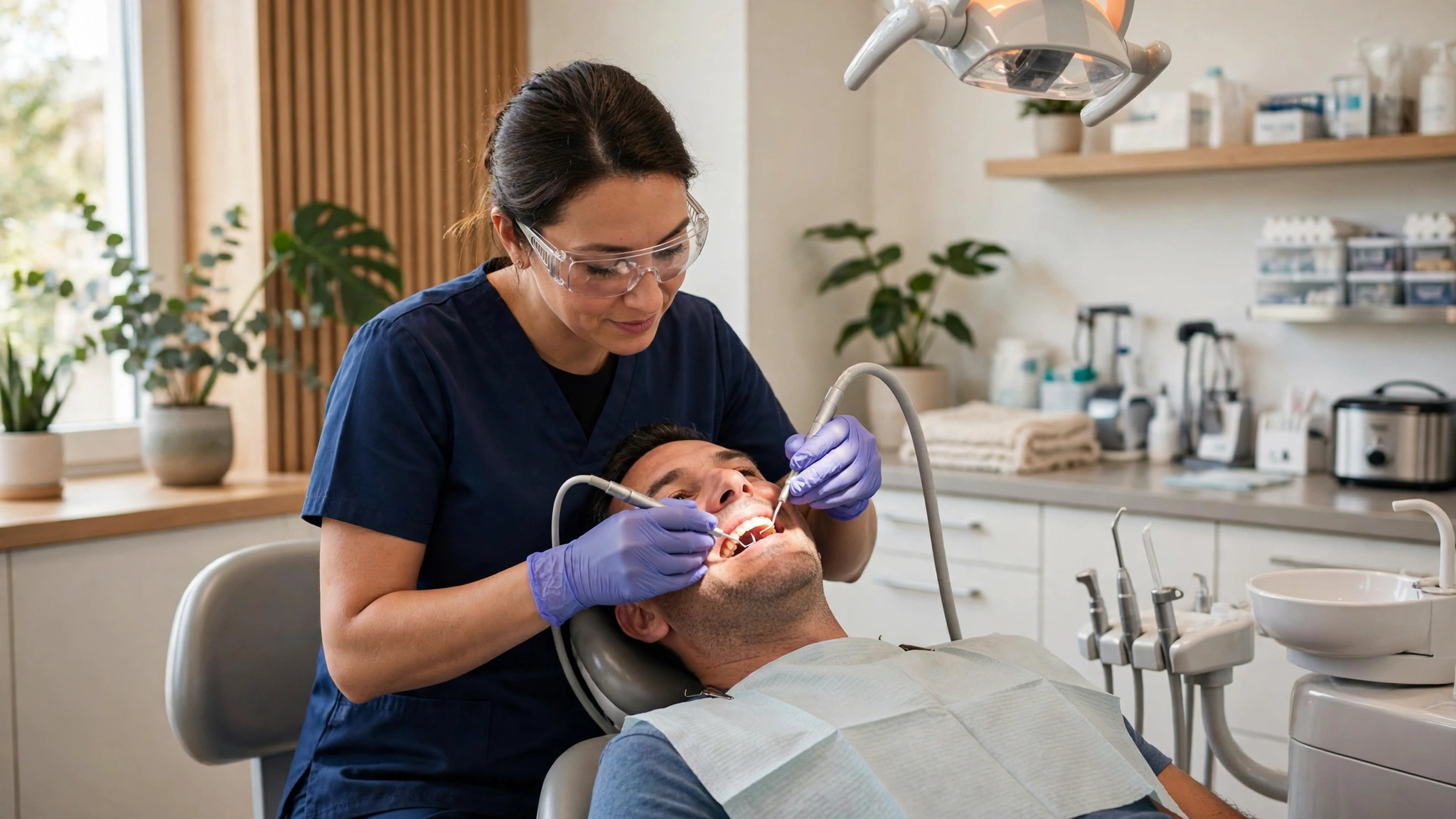
We start with the numbers. Periodontal charting records the pocket depth around every tooth, plus bleeding and recession, so the plan targets measured disease rather than a general impression. Your diabetes history is part of that record, including your most recent HbA1c if you know it.
If the measurements show disease, scaling and root planing is done here, one side of the mouth at a time, usually over two visits. Pockets are then re-measured to see how they responded, which is how we know whether the treatment worked rather than assuming it did. From there a maintenance interval is set by your readings, not by a fixed rule.
Where pockets stay deep after thorough non-surgical care, referral to a periodontist for surgical options is the responsible next step. We also coordinate with your physician when a case needs it, because a patient whose HbA1c is 9 and rising needs that conversation had by both clinicians, not one.
What we will not do is tell you a cleaning will fix your diabetes. It will help your gums and it may help your average blood sugar by a measurable but modest amount.
What it costs in Temecula
The fees that apply are published. A new-patient examination is $195, including radiographs and a written plan. A routine cleaning is $205. A deep cleaning is $195 per quadrant, and periodontal maintenance afterwards is $295 per visit.
A full mouth is four quadrants, so deep cleaning of the whole mouth is four times the quadrant fee. Which you need is decided by pocket measurements taken at an examination, not by how the gums look or by how long it has been since your last visit.
If you have dental insurance, deep cleaning is usually covered as a periodontal service rather than a preventive one, which often means a different percentage and sometimes a waiting period. Ask for the benefits to be checked in writing before treatment so the estimate you receive is the one you pay.
When to call us, and when to go to the ER
Call us if your gums bleed when you brush, if they have pulled away from a tooth, if a tooth feels loose, if you have bad breath that does not change with brushing, or if a sore in your mouth has not healed in two weeks. Call (951) 577-8090, Monday to Friday, 10:00 am to 5:00 pm. An online request is not a confirmed appointment.
Go to the ER or call 911 for facial swelling spreading toward an eye or throat, swelling that closes an eye, fever with a swollen face, trouble swallowing or breathing, or bleeding you cannot stop with steady pressure. If you take insulin and feel shaky, sweaty or confused before an appointment, treat the low blood sugar first and reschedule. A dental visit is never worth a hypoglycaemic episode.
Common questions
Should I eat before my dental appointment if I take insulin?
Yes, eat normally and take your medication as usual unless your physician has told you otherwise for a specific procedure. Bring a fast source of sugar, tell the team you have diabetes when you arrive, and mention your most recent reading. NIDDK advises asking how often to check your blood glucose before and after a procedure, and whether any medicine timing should change.
Will deep cleaning make my blood sugar drop too low?
No. Scaling and root planing does not lower blood sugar acutely the way insulin does. The 0.43-point change is an average measured over three to four months, not an effect you would feel during an appointment.
My gums do not hurt. Could I still have periodontitis?
Yes, and this is the usual case. Periodontitis causes no discomfort until it is advanced, which is why measurements rather than symptoms are what diagnose it. NIDDK lists receding gums, loose teeth, widening gaps between teeth and persistent bad breath among the signs, and none of them involves pain.
Does vaping affect my gums the way smoking does?
The evidence is thinner than for cigarettes, but the direction is not reassuring. Smoking is already established as a major modifiable risk factor for periodontal disease, and nicotine exposure from vaping is the mechanism most often proposed. If you vape and your gums bleed or have receded, treat it as a risk factor worth mentioning rather than a safe alternative.
Sources
- Simpson TC, Clarkson JE, Worthington HV, et al. Treatment of periodontitis for glycaemic control in people with diabetes mellitus. Cochrane Database Syst Rev. 2022;4(4):CD004714. https://pubmed.ncbi.nlm.nih.gov/35420698/
- Stöhr J, Barbaresko J, Neuenschwander M, Schlesinger S. Bidirectional association between periodontal disease and diabetes mellitus: a systematic review and meta-analysis of cohort studies. Sci Rep. 2021;11(1):13686. https://pubmed.ncbi.nlm.nih.gov/34211029/
- Bitencourt FV, Nascimento GG, Costa SA, et al. Co-occurrence of Periodontitis and Diabetes-Related Complications. J Dent Res. 2023;102(10):1088-1097. https://pubmed.ncbi.nlm.nih.gov/37448314/
- Bitencourt FV, Andersen A, Bjerg L, et al. Periodontitis and Diabetes Complications: A Danish Population-Based Study. J Dent Res. 2024;103(9):870-877. https://pubmed.ncbi.nlm.nih.gov/39104154/
- Eke PI, Dye BA, Wei L, Thornton-Evans GO, Genco RJ. Prevalence of periodontitis in adults in the United States: 2009 and 2010. J Dent Res. 2012;91(10):914-20. https://pubmed.ncbi.nlm.nih.gov/22935673/
- Garcia D, Tarima S, Okunseri C. Periodontitis and glycemic control in diabetes: NHANES 2009 to 2012. J Periodontol. 2015;86(4):499-506. https://pubmed.ncbi.nlm.nih.gov/25427615/
- Cao R, Li Q, Wu Q, Yao M, Chen Y, Zhou H. Effect of non-surgical periodontal therapy on glycemic control of type 2 diabetes mellitus: a systematic review and Bayesian network meta-analysis. BMC Oral Health. 2019;19(1):176. https://pubmed.ncbi.nlm.nih.gov/31387569/
- Baeza M, Morales A, Cisterna C, et al. Effect of periodontal treatment in patients with periodontitis and diabetes: systematic review and meta-analysis. J Appl Oral Sci. 2020;28:e20190248. https://pubmed.ncbi.nlm.nih.gov/31939522/
- NIDCR. Diabetes and Oral Health. https://www.nidcr.nih.gov/health-info/diabetes
- NIDDK. Diabetes, Gum Disease, & Other Dental Problems. https://www.niddk.nih.gov/health-information/diabetes/overview/preventing-problems/gum-disease-dental-problems
- American Dental Association. Diabetes. https://www.ada.org/resources/ada-library/oral-health-topics/diabetes
- American Dental Association. Diabetes and dental health. MouthHealthy. https://www.mouthhealthy.org/all-topics-a-z/diabetes
Results vary between patients. This article is general information and is not a substitute for an examination or for medical care.
Book an assessment
If you have diabetes and your gums have not been measured, that is the appointment worth making. Call (951) 577-8090 or request a visit. Read more about periodontal care at Paris Dental and what deep cleaning involves. If your gums are bleeding, what bleeding means explains when to book. If your mouth is dry, why dry mouth damages teeth covers the diabetes connection in more detail. For the wider question of what gum disease can and cannot reverse, see what gum disease treatment can achieve.
Common questions
Does gum disease affect blood sugar?
Yes, and the effect is measurable. A Cochrane review of 35 randomised trials with 3,249 participants found that treating periodontitis lowered HbA1c by 0.43 percentage points at three to four months compared with no treatment or usual care. That is moderate-certainty evidence, which is a stronger statement than most dental claims can make.
Does diabetes cause gum disease?
It raises the risk substantially. A meta-analysis of 15 cohort studies with 295,804 participants found that people with diabetes were 1.24 times more likely to develop periodontitis. The association runs both ways: people with periodontitis were 1.26 times more likely to develop diabetes.
Will treating my gums cure my diabetes?
No. Treating gum disease is not a treatment for diabetes and does not replace medication, diet or monitoring. What the evidence supports is a modest improvement in average blood sugar alongside medical care. Anyone claiming a dental cleaning replaces diabetes treatment is overstating the evidence.
How often should someone with diabetes see a dentist?
The interval is set by your gum measurements, not by the fact that you have diabetes. Someone with healthy gums and good control may be fine on a routine schedule. Someone with treated periodontitis is usually seen more often, because the disease is controlled rather than eliminated. Ask what your pocket depths justify.
Why does diabetes make gum disease worse?
High blood glucose changes several things at once. It reduces saliva, which lets plaque build faster. It increases glucose in saliva, which feeds bacteria. It also impairs healing and the immune response, so the same amount of plaque causes more destruction. NIDCR lists gum disease, dry mouth and thrush among the mouth problems raised by diabetes.
Is there a link between gum disease and other diabetes complications?
There is an association. A Danish study of 15,922 people with type 2 diabetes found that diabetic neuropathy raised the odds of moderate to severe periodontitis by 1.36 times, retinopathy by 1.21 times, and having both raised them 1.51 times. That does not prove cause, but it does mean gum disease tends to cluster with other complications.
What does periodontal treatment cost at Paris Dental?
A new-patient examination is $195 and includes radiographs and a written plan. A routine cleaning is $205, a deep cleaning is $195 per quadrant, and periodontal maintenance afterwards is $295 per visit. A full mouth is four quadrants. What you need is decided by pocket measurements, not by symptoms.