



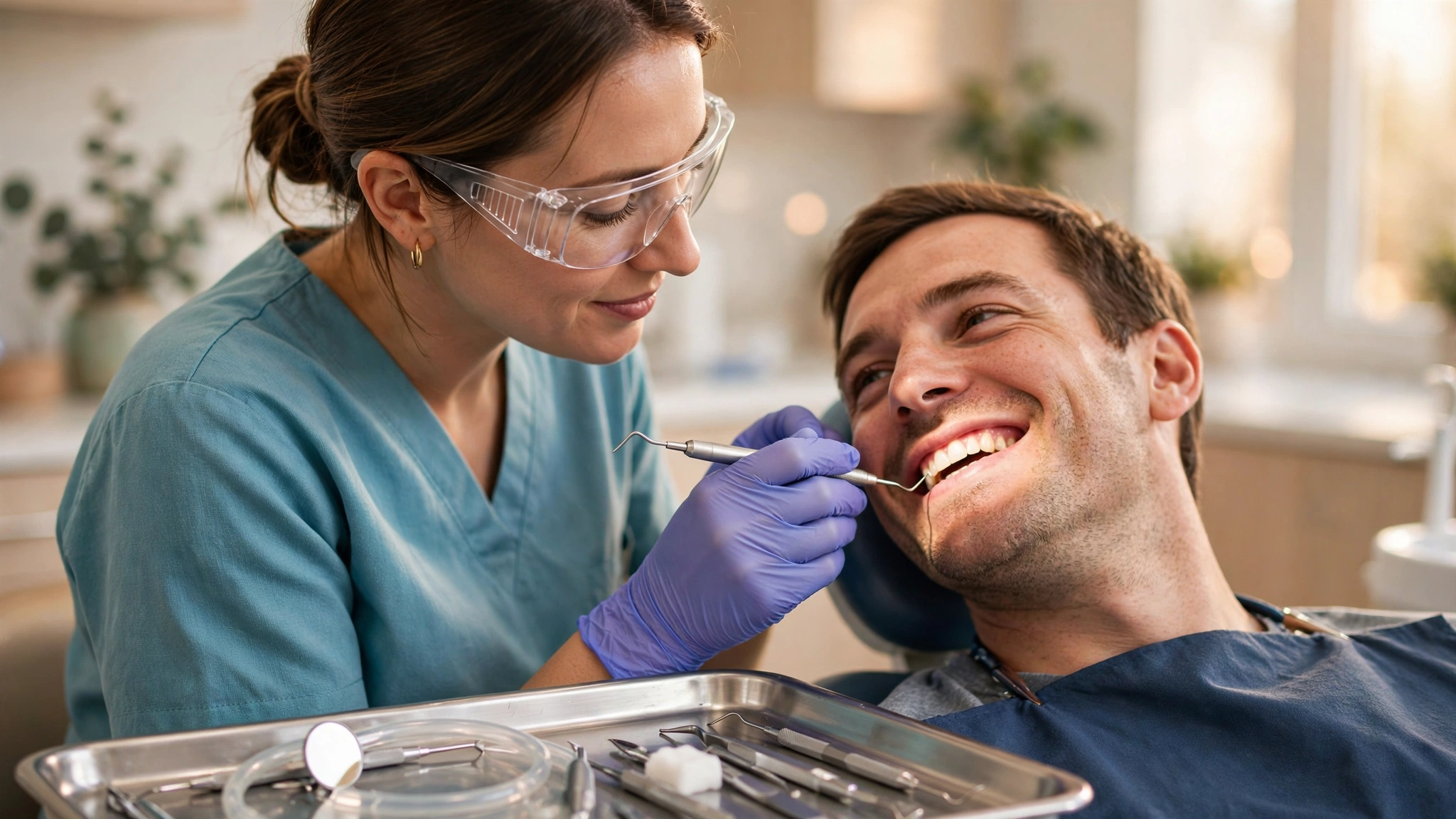
Most cavity prevention is done at home, twice a day, with a tube of fluoride toothpaste. That is the intervention with the largest body of evidence and the lowest cost. Everything else — varnish, sealants, rinses, gum — adds to it or fills a specific gap.
This page ranks prevention by how strong the evidence is, not by how good the products sound.
Key facts
| Detail | |
|---|---|
| Strongest single step | Fluoride toothpaste, twice a day |
| Fluoride varnish effect | 43% fewer decayed surfaces, per a Cochrane review of 22 trials |
| Sealant effect | 11% to 51% fewer cavities in back teeth at 24 months |
| Adults 20–64 with an untreated cavity | 1 in 5 (21%), per the CDC |
| Children 6–9 who have had a cavity | Half (50%), per the CDC |
| Critical pH for enamel | About 5.5 — below this, enamel dissolves |
| Free sugars, WHO limit | Less than 10% of energy intake |
How does a cavity actually start?
A cavity is a mineral loss, not a stain or a germ arriving from outside.
Bacteria in plaque eat fermentable carbohydrate — mostly sugar — and make acid. That acid sits against the enamel. When the local pH drops below about 5.5, the acid starts dissolving the mineral in the enamel surface. The ADA's information sheet on oral care product pH puts the critical pH for enamel dissolution at about 5.5, and notes that the actual figure shifts with the calcium and phosphate in the saliva touching the tooth.
Saliva then reverses it. Bicarbonate in saliva neutralises the acid, and calcium and phosphate in saliva rebuild the mineral. This is why the NIDCR describes decay as stoppable and reversible before a hole forms: enamel repairs itself using minerals from saliva and fluoride.
A cavity is what happens when the dissolving outpaces the rebuilding for long enough.
That single mechanism explains almost every prevention method below. Each one either reduces how often the pH drops, or speeds the rebuilding.
Why does sugar frequency matter more than sugar amount?
Because each sugar exposure starts a new acid attack, and the enamel has to survive all of them.
The plaque pH does not return to safe immediately. A 2012 numerical model of plaque acid production cited in a 2026 review found that a two-minute glucose exposure drove biofilm pH down to between 4.5 and 5, and that it took about 40 minutes for the pH to climb back above the critical 5.5 threshold — and about 140 minutes to return to its resting value.
So a bag of sweets eaten at once is one acid attack of about 40 minutes. The same bag eaten across a morning is a morning of continuous acid. The total sugar is identical. The damage is not.
The WHO guideline on sugars intake recommends that adults and children reduce free sugars to less than 10% of total energy intake, on a strong recommendation, with a further reduction below 5% suggested conditionally. The same guideline records that caries rates are higher above that 10% line than below it, and that a dose-response relationship was seen even well below it.
The practical version: fewer sugary moments per day beats a smaller total spread across the day. Water instead of sipping a soft drink for two hours is a larger change than most people expect.
What does fluoride do that toothpaste alone does not?
Fluoride does two things, and neither is "killing the bacteria".
First, it slows the demineralisation — the acid has a harder time pulling mineral out of enamel that has fluoride in it. Second, it speeds remineralisation, and the mineral laid down is more resistant to the next acid attack.
The evidence is broad and consistent. A Cochrane review of 96 studies, published 2019, found that fluoride toothpaste reduces decay compared with non-fluoride toothpaste, and that a dose-response effect exists: higher fluoride concentration gives slightly better results in children and adolescents. The review also warned that higher-fluoride toothpaste raises the risk of fluorosis in teeth still forming, so the strength has to be balanced against age.
The concentration gap is smaller than the marketing suggests. Brushing twice a day with an ordinary paste beats a high-strength paste used irregularly.
A separate Cochrane review of fluoride varnish — 22 trials, 12,455 children — found the pooled prevented fraction for permanent tooth surfaces was 43% (95% CI 30% to 57%) compared with placebo or no treatment, and 37% for primary teeth. The authors rated that evidence moderate quality, and noted that most included trials had a high risk of bias.
In plain terms: varnish is a genuinely effective professional treatment, and the 43% figure comes with real uncertainty attached to it.
Do sealants work?
Yes, on the surfaces where decay starts in grooves.
The chewing surfaces of molars have pits and fissures narrower than a toothbrush bristle. A sealant fills them with a thin resin barrier so plaque cannot sit in the base of the groove.
A Cochrane review of 38 trials with 7,924 children found moderate-quality evidence that resin-based sealants reduced caries in first permanent molars by between 11% and 51% at 24 months compared with no sealant, with similar results up to 48 months.
The range is wide because the benefit depends on how much decay the mouth would otherwise get. The review works this out on three assumed baselines. If 16% of control surfaces decayed over 24 months, sealing cut that to 5.2%. At a 40% baseline, it cut 40% down to 6.25%. At a 70% baseline, it cut 70% down to 19%. In a mouth at low risk, a sealant prevents few cavities. In a mouth at high risk, it prevents many.
Glass ionomer sealants and the question of which sealant material is better remain unresolved in that review — the evidence was rated very low quality.
What about xylitol and sugar-free gum?
Less than the packaging claims.
A Cochrane review of xylitol-containing products — 10 studies, 5,903 participants — found low-quality evidence that a fluoride toothpaste containing 10% xylitol reduced caries by about 13% over 2.5 to 3 years compared with fluoride-only toothpaste. The review's authors urged caution, because that estimate came from two studies by the same authors in the same population.
For every other xylitol product — gum, lozenges, syrup — the review could not conclude whether a benefit exists. That is not the same as proving there is none. It means the trials were not good enough to answer the question.
Chewing sugar-free gum after a meal does have a mechanical benefit that does not depend on xylitol: it increases saliva flow, and saliva is what neutralises the acid. That benefit is real and cheaper than a supplement.
What can you change this week?
Sort these by effort, not by importance. The first three do most of the work.
Use a fluoride toothpaste, twice a day, for two minutes. Check the tube for the ppm figure. This is the step with the strongest evidence and it costs nothing extra.
Clean between the teeth once a day. Floss or interdental brushes reach the surfaces a toothbrush cannot. Cavities between teeth are invisible until they are large, which is why they are the ones found on X-rays.
Cut the number of sugary moments, not just the amount. Replace a sipped drink with water. Move a snack to mealtime. Every one of those changes removes an acid attack rather than shortening it.
Do not brush straight after an acidic drink. Enamel softened by acid is more vulnerable to abrasion. Wait, or rinse with water first.
Ask about varnish and sealants at your next visit. These are the two professional treatments with the strongest evidence behind them, and both are cheap relative to a filling. Also check the tool itself: a brush with splayed bristles removes less plaque, which is why the three-to-four-month replacement rule is about cleaning power rather than germs.
Treat dry mouth seriously. Saliva is the repair mechanism. Medicines, some medical conditions and mouth breathing all reduce it, and less saliva means slower repair.
For a child in the house, the first tooth changes the routine. Teething is not a reason to delay cleaning, and it is a reason to avoid numbing gels: what teething really causes and what to never put on the gums covers the safe options.
How we do it at Paris Dental
At an examination we look at the surfaces, not just the teeth you can see in a mirror. We check the grooves of the molars with an explorer, look at the margins of existing fillings, and take bitewing radiographs where they show the contacts between teeth.
Then we tell you which of your teeth are at risk and why, in terms you can act on. A patient with no decay history and good saliva does not need the same plan as a patient with three new cavities in two years, or one with receding gums exposing root surfaces that decay faster than enamel.
If sealants or fluoride varnish are appropriate, we say so and explain what the evidence supports. If your decay risk is low, we say that too and do not sell treatment you do not need. Results vary between patients.
What it costs
Every fee below is from our published price list.
| Treatment | Fee | Unit |
|---|---|---|
| New-patient examination, with radiographs and a written plan | $195 | per visit |
| Routine cleaning (prophylaxis) | $205 | per visit |
| Fluoride treatment | $45 | per visit |
| Sealant | $95 | per tooth |
| Intraoral radiograph | $25 | per film |
| Panoramic radiograph | $195 | per image |
| Tooth-coloured filling, one surface | $195 | per tooth |
| Tooth-coloured filling, several surfaces | $295 | per tooth |
| Deep cleaning (scaling and root planing) | $195 | per quadrant |
| Periodontal maintenance | $295 | per visit |
Compare the prevention column with the repair column. A sealant is $95. A one-surface filling is $195, and a filling is not the end of the story — a restored tooth needs watching and eventually replacing.
Every fee is on our full treatment price list. HSA and FSA funds can usually be used for all of these.
When to call us
Call (951) 577-8090 if you have:
- A rough spot, pit or dark groove you want checked
- Sensitivity to sweet, cold or hot that lasts a few seconds
- Food trapping repeatedly in one place
- Gums that bleed when you brush
- A dry mouth that has persisted for weeks
- A filling that feels rough or has chipped at the edge
Go to an emergency room or call 911 if you have facial swelling with fever, swelling spreading toward the eye or neck, or difficulty swallowing or breathing. That is a spreading infection and needs urgent medical care.
Common questions
Is mouthwash a substitute for brushing? No. It reaches surfaces but does not remove plaque mechanically, and it does not deliver the sustained fluoride dose of toothpaste.
Does oil pulling prevent cavities? There is no good evidence that it reduces decay. It is not a replacement for fluoride, and the trials that exist are small and poorly controlled.
Is fluoride safe for children? The Cochrane review treats the benefit as established and the risk as fluorosis — cosmetic enamel marks in teeth still forming — which is why the concentration for young children should be balanced against that risk. Ask us what strength suits your child's age.
I have not had a cavity in years. Do I need all this? Prevention should be matched to risk. If your risk is low, the honest plan is a check-up, a cleaning and fluoride toothpaste. Say that at the visit and we will tell you whether we agree.
Can a cavity be reversed? Only before the surface breaks. Once there is a hole, the tooth needs a filling. The stage is what decides it — see what a cavity looks like at each stage.
Sources
- NIDCR. Tooth Decay. https://www.nidcr.nih.gov/health-info/tooth-decay
- Centers for Disease Control and Prevention. Oral Health Surveillance Report: Dental Caries, Tooth Retention, and Edentulism, United States, 2017–March 2020. 2024. https://www.cdc.gov/oral-health/php/2024-oral-health-surveillance-report/selected-findings.html
- Walsh T, Worthington HV, Glenny AM, Marinho VCC, Jeroncic A. Fluoride toothpastes of different concentrations for preventing dental caries. Cochrane Database of Systematic Reviews. 2019;3:CD007868. https://pubmed.ncbi.nlm.nih.gov/30829399/
- Marinho VCC, Worthington HV, Walsh T, Clarkson JE. Fluoride varnishes for preventing dental caries in children and adolescents. Cochrane Database of Systematic Reviews. 2013;7:CD002279. https://pubmed.ncbi.nlm.nih.gov/23846772/
- Ahovuo-Saloranta A, Forss H, Walsh T, et al. Pit and fissure sealants for preventing dental decay in permanent teeth. Cochrane Database of Systematic Reviews. 2017;7:CD001830. https://pubmed.ncbi.nlm.nih.gov/28759120/
- Riley P, Moore D, Ahmed F, Sharif MO, Worthington HV. Xylitol-containing products for preventing dental caries in children and adults. Cochrane Database of Systematic Reviews. 2015;3:CD010743. https://pubmed.ncbi.nlm.nih.gov/25809586/
- World Health Organization. Guideline: Sugars Intake for Adults and Children — Executive summary. 2015. https://ncbi.nlm.nih.gov/books/NBK285538
- American Dental Association. Information Sheet on pH of Home Oral Care Products. 2019. https://www.ada.org/-/media/project/ada-organization/ada/ada-org/files/resources/research/hpi/sci_2019information-sheet-on-ph-of-home-oral-care-products_final_aug2019.pdf
- Enax J, Schulze zur Wiesche E, Epple M. Tooth Enamel Demineralization: Caries and Erosion from the Viewpoint of Chemistry. Dentistry Journal. 2026;14(6):387. https://pmc.ncbi.nlm.nih.gov/articles/PMC13298224
Results vary between patients. This article is general information and is not a substitute for an individual examination.
Book an examination
If you want to know your own decay risk rather than the average person's, an examination answers it. Call (951) 577-8090 or request a visit. We are at 31285 Temecula Pkwy Ste 205, Temecula, CA 92592, open Monday to Friday, 10:00 am to 5:00 pm.
For the stage-by-stage appearance of decay, read what a cavity looks like. For the cleaning that removes the plaque the acid comes from, read how to remove plaque and tartar. For the between-teeth surfaces, read how to floss correctly.
Common questions
What is the single most effective way to prevent cavities?
Brushing twice a day with a fluoride toothpaste. A Cochrane review of 96 studies found fluoride toothpaste reduces decay compared with non-fluoride toothpaste, and that higher fluoride strength gives slightly better results. It costs nothing extra.
Does fluoride actually prevent cavities?
Yes, and the strongest evidence is for varnish. A Cochrane review of 22 trials with 12,455 children found fluoride varnish reduced decay on permanent tooth surfaces by 43% compared with placebo or no treatment. That evidence was rated moderate quality.
Is it better to reduce sugar or to brush more?
Both matter, but they do different jobs. Brushing with fluoride repairs and protects enamel. Reducing how often sugar hits the teeth reduces how many acid attacks the enamel has to survive. For most people the frequency of sugar is the easier thing to change.
Do sealants prevent cavities?
Yes, in the deep grooves of back teeth. A Cochrane review of 38 trials with 7,924 children found resin sealants reduced decay in first permanent molars by 11% to 51% at 24 months compared with no sealant, on moderate-quality evidence.
How often should I get a fluoride treatment?
There is no single schedule that fits everyone. A dentist sets it by your decay history, dry mouth, gum condition and root exposure. Some adults need it twice a year, some need it more often, and some with no decay history need it rarely.
Can I prevent cavities without a dentist?
You can reduce risk substantially with fluoride toothpaste, cleaning between the teeth and fewer sugary snacks. You cannot check the surfaces between your teeth or under old fillings, and those are where the cavities easiest to miss begin. Results vary between patients.