



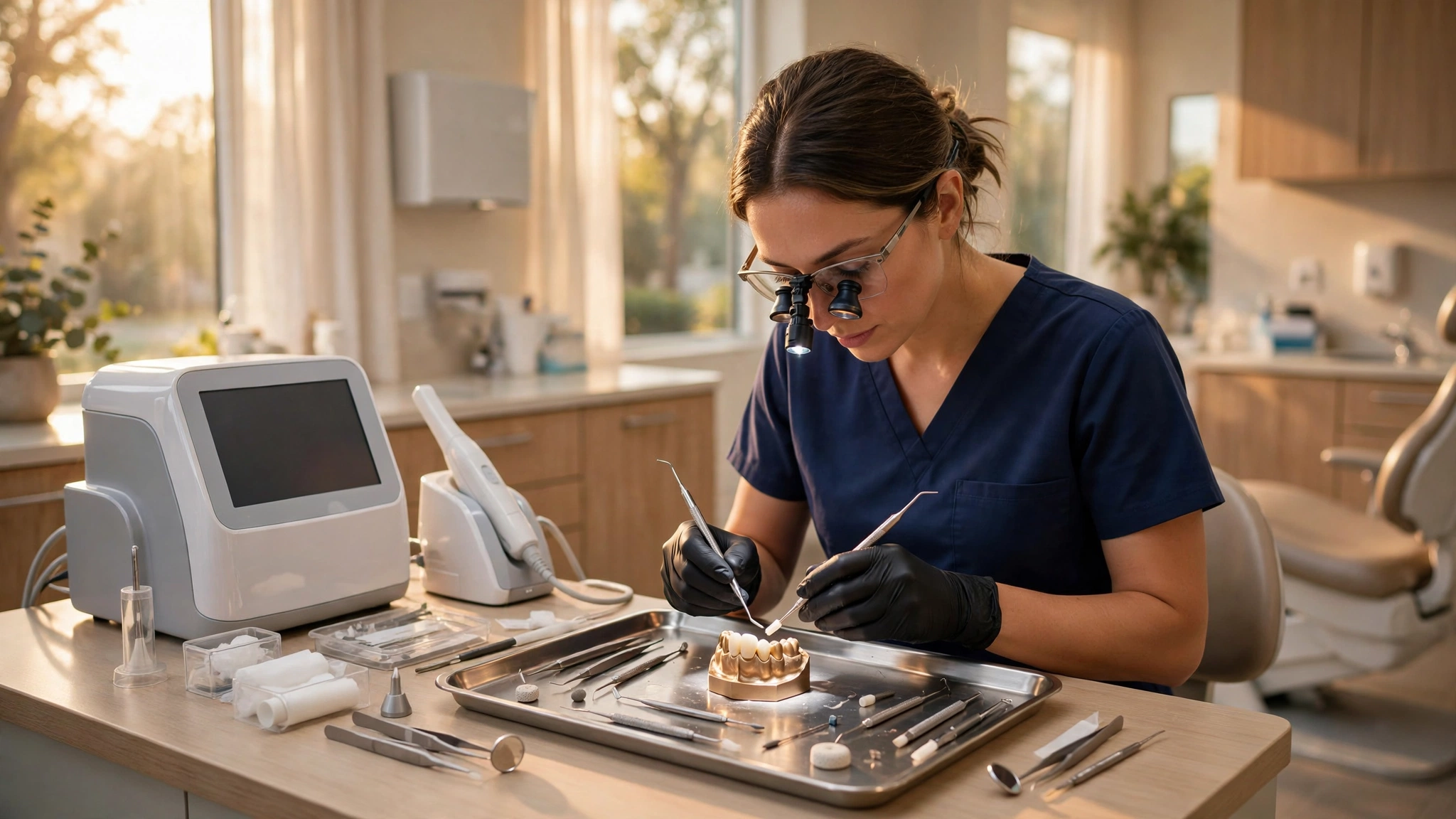
A dental crown is a cap that covers the whole visible part of a tooth. It is made outside the tooth, then cemented on, and it becomes the tooth's new outer surface. A dentist recommends one when a tooth has lost too much structure for a filling to hold together, or when a root-filled back tooth needs protecting from fracture.
This page covers what a crown is, which materials exist, what the published survival rates are, and where crowns actually fail. It is the general explanation. Our dental crowns in Temecula page covers the appointment itself.
Key facts
| Detail | |
|---|---|
| What it covers | The whole visible crown of the tooth, above the gum line |
| Five-year survival, strongest material | 98.5% for monolithic lithium disilicate |
| Five-year survival, worst material | 90.4% for feldspathic ceramic |
| Where most crowns fail | The margin, where crown meets tooth |
| Typical number of visits | One for CEREC, two for a laboratory crown |
| Fee at Paris Dental | $1,295 per tooth, either type |
What is actually under a crown?
A crown is not a new tooth. It is a shell over the tooth you already have.
Before a crown is made, the dentist removes tooth structure all round the tooth so the cap has room to sit. What remains is called the preparation. If too little remains to support a crown, the dentist builds the core back up first, often with a post and core.
That is the part patients do not expect. A crown needs a sound tooth underneath it. A crown on a tooth with almost nothing left will come loose, because there is nothing for the cement to grip.
So the question at the examination is not "can this tooth have a crown". It is "does enough sound tooth remain to hold one". Sometimes the honest answer is no, and the honest alternative is an extraction.
What are the types of crown?
Two things vary: what the crown is made of, and how it is made.
By material. Metal-ceramic has a metal core with porcelain fused over it. It is strong and it has the longest track record. Monolithic zirconia is one piece of zirconia, very strong, and it does not chip the way a layered crown can. Monolithic lithium disilicate is a glass-ceramic, tooth-coloured and the strongest of the ceramics for appearance on a front tooth. Feldspathic ceramic is the most lifelike and the weakest.
By method. A laboratory crown is made by a technician from a scan or impression, and it is fitted about two weeks later. A same-day crown is designed and milled in the practice from a ceramic block, and it is fitted in the same appointment. You can read a direct comparison in same-day crowns versus laboratory crowns.
Neither method is better in the abstract. A laboratory crown gives a technician more control over colour and layering, which matters on a front tooth. A milled crown avoids a temporary and a second appointment, which matters on a back tooth.
How long does a crown last?
This is the question with real published numbers, so here they are.
A 2026 systematic review and meta-analysis by Pjetursson and colleagues pooled 64 studies covering 3,509 metal-ceramic and 8,051 all-ceramic single crowns. It reported five-year survival by material:
| Material | Five-year survival |
|---|---|
| Monolithic lithium disilicate | 98.5% |
| Veneered densely-sintered zirconia | 97.3% |
| Metal-ceramic | 97.1% |
| Monolithic densely-sintered zirconia | 96.8% |
| Veneered leucite or lithium-disilicate ceramic | 95.7% |
| Densely-sintered alumina | 94.5% |
| Glass-infiltrated alumina | 94.3% |
| Feldspathic or silica-based ceramic | 90.4% |
Read the spread honestly. The gap between the top and the bottom is about eight percentage points over five years. Feldspathic ceramic, glass-infiltrated alumina, densely-sintered alumina and veneered leucite ceramic were significantly worse than monolithic lithium disilicate. Metal-ceramic and monolithic zirconia were not.
That last point matters more than the ranking. It means the choice between a modern monolithic ceramic and metal-ceramic is mostly about appearance and wear, not about which one survives.
Survival is also not the same as success. A 2026 review of zirconia restorations by Ma and colleagues, covering 66 studies, found pooled survival of 92.9% to 98.7% for single crowns up to ten years. But success, meaning no complication at all, was 46.1% at ten years, with mechanical complications in 53.9%.
So a crown very often stays on the tooth. It does not always stay problem-free. Those are different promises, and only the first one is usually quoted.
Did you know: a crown does not stop decay, it moves where decay happens
A crown covers the top and sides of a tooth. It does not cover the join.
That join, the margin, is a ledge of cement and tooth just at or below the gum line. Plaque collects there. The tooth under the crown is still alive, still has nerves and blood supply in the root, and can still decay. When it does, you often cannot see it, because the crown hides it.
This is why the margin is the single most important part of the crown and the part you cannot inspect. A crown that fits badly at the margin fails years earlier than one that fits well; a 2026 randomised paired study of posterior zirconia and lithium disilicate crowns measured marginal gap directly with a replica technique and followed the restorations for five years. It is also why cleaning at the gum line every day matters more than anything you do to the top of the crown, which nothing can damage.
Did you know: gold has the lowest failure rate of any crown material
A 2020 network meta-analysis in the Journal of the American Dental Association compared treatment options for large restorations in back teeth. It included 43 studies with at least five years of follow-up.
Annual failure rates were 0.29% for gold, 0.52% for metal-ceramic, and 2.19% for direct resin composite. Gold won.
That finding rarely reaches patients, because almost nobody wants a gold back tooth. But it sets a useful benchmark. It shows that the strongest predictor of a crown lasting is not how new the material is. It is how well the material behaves under repeated load, and how well it seals at the margin.
Did you know: grinding does less damage to a modern crown than expected
Bruxism is the reason many patients are told they need a particular crown. A three-year randomised controlled trial of 109 patients needing a molar crown put them into four groups: lithium disilicate or zirconia, each with and without sleep bruxism.
Survival was 95.2% to 100% across all groups. Success ranged from 81.5% to 95.8%. There were no technical complications during the three years, and no statistically significant difference between bruxers and non-bruxers, or between the two materials.
This does not mean grinding is harmless. Three years is a short window for a crown, and the study was small. It does mean a diagnosis of bruxism is not on its own a reason to rule out a ceramic crown. A night guard protects the crown and the teeth around it, and it is a cheaper decision than changing material.
Did you know: ceramic crowns wear the tooth opposite them
A crown does not just sit there. It rubs against the tooth above or below it, thousands of times a day.
A 2026 systematic review and meta-analysis of nine clinical studies with 203 patients measured how much natural enamel the opposing tooth lost. Monolithic zirconia caused measurable wear, with a mean difference of -1.32. Lithium disilicate caused less, at -0.45. Feldspathic ceramic did not show significant wear.
All of these were greater than enamel wearing against enamel. So the honest statement is that ceramic crowns cause more wear on the opposing tooth than a natural tooth does, and that different ceramics differ.
On a back tooth, that opposing tooth is often another crown, and wear is not a concern. On a front tooth meeting a natural lower tooth, it is a real consideration. It is one of the reasons a material choice belongs to a specific tooth, not to a patient.
How we do it at Paris Dental
We start by asking whether the tooth needs a crown at all.
An examination with radiographs shows how much sound structure is left, whether the nerve is involved, and whether the tooth can be restored rather than extracted. We show you the image and point at what we are describing.
If a crown is right, we say which type and why, in terms of that tooth. A front tooth gets a material chosen for how light passes through it. A back tooth gets a material chosen for strength. If a same-day crown suits the case, you can leave with it finished.
If the tooth is too broken down for a crown to hold, we say that too, and we discuss the alternatives rather than proceeding. Results vary between patients.
What it costs
Every fee below is from our published price list.
| Treatment | Fee | Unit |
|---|---|---|
| Same-day CEREC crown | $1,295 | per tooth |
| Laboratory crown (porcelain or zirconia) | $1,295 | per tooth |
| Post and core | $195 | per tooth |
| Root canal treatment, anterior tooth | $595 | per tooth |
| Root canal treatment, molar | $995 | per tooth |
| Inlay or onlay (an alternative to a full crown) | $495 | per tooth |
| Tooth-coloured filling, multiple surfaces | $295 | per tooth |
| New-patient examination, with radiographs and a written plan | $195 | per visit |
| CBCT (3D scan) | $295 | per scan |
| Night guard | $395 | per guard |
| Simple extraction | $295 | per tooth |
| Complete single-tooth implant (implant, abutment and crown) | $4,085 | per tooth |
A crown fee covers the crown, the scan or impression, and the fitting. It does not cover a post and core if structure is missing, a root canal if the nerve is involved, or an extraction if the tooth cannot be saved. You get those numbers in writing before anything starts.
Compare the two honest paths. A crown on a tooth that can be saved is $1,295. An extraction is $295, but it leaves a gap, and replacing that tooth with an implant costs $4,085. Keeping your own tooth is usually the cheaper option over time, as long as it can be restored.
Every fee is on our full treatment price list. HSA and FSA funds can usually be used.
When to call us
Call (951) 577-8090 if you have:
- A tooth that has cracked, or a large filling that has started to break down
- A crown that feels loose, or that has come off
- Food trapping constantly at the edge of a crown
- A rough edge you can feel with your tongue
- A tooth that has darkened under a crown
- Been told you need a crown and want a second opinion on whether you do
Go to an emergency room or call 911 if you have facial swelling with fever, swelling spreading toward the eye or neck, or difficulty swallowing or breathing. That is a spreading infection and needs urgent medical care, not a routine appointment.
Common questions
Does getting a crown hurt? The preparation is done under local anaesthetic, so the appointment itself should not be uncomfortable. Mild sensitivity to cold for a few days afterwards is normal. Tell us if it does not settle.
Will the crown match my other teeth? We match shade and shape to your neighbouring teeth before anything is made. On a front tooth, a laboratory crown gives better control over how light passes through the ceramic. Results vary, and the surrounding teeth keep changing colour while a crown does not.
Can a crown be repaired instead of replaced? Sometimes. A small chip at the edge can often be polished or filled. A crown that has come loose because the cement failed can usually be re-cemented. A crown over a tooth that has decayed underneath usually needs replacing.
What happens if I do not treat the tooth? A cracked or heavily broken-down tooth does not heal. The crack propagates, and eventually the tooth splits in a way that cannot be saved. That is why a crown on a root-filled back tooth is a structural decision and not a cosmetic one.
Is a crown the same as a veneer? No. A veneer covers only the front face of a tooth and removes very little structure. A crown covers the whole visible tooth and removes much more. Veneers are for appearance on sound teeth; crowns are for teeth that need holding together. See porcelain veneers if appearance is the only issue.
Can I eat normally with a crown? Yes, once it is fitted and the bite is adjusted. Avoid very hard foods on the new crown for the first week. After that, treat it as a normal tooth and clean it as carefully as the rest.
Sources
- Pjetursson BE, Pitta J, Balet A, et al. A Systematic Review and Meta-analysis Evaluating the Survival, Failure, and Complication Rates of Metal-Ceramic, Veneered, and Monolithic All-Ceramic Tooth-Supported Single Crowns — Part 1. International Journal of Prosthodontics. 2026;39:308-324. https://pubmed.ncbi.nlm.nih.gov/41489982/
- Ma Y, Xuan Y, Cheng W, et al. Clinical outcomes of zirconia dental restorations: A systematic review and meta-analysis. Journal of Dentistry. 2026;175:106974. https://pubmed.ncbi.nlm.nih.gov/42575241/
- Vetromilla BM, Opdam NJ, Leida FL, et al. Treatment options for large posterior restorations: a systematic review and network meta-analysis. Journal of the American Dental Association. 2020;151:614-624.e18. https://pubmed.ncbi.nlm.nih.gov/32718491/
- Khalid A, Al-Jewair T. Do sleep bruxism patients experience higher complication or failure rates with monolithic lithium disilicate or zirconia molar crowns? Evidence-Based Dentistry. 2026;27:56-57. https://pubmed.ncbi.nlm.nih.gov/42323516/
- Rosa CDDRD, Bento VAA, Duarte ND, et al. Comparative Wear of Opposing Natural Enamel by Different Ceramic Materials in Fixed Dental Prostheses: A Systematic Review and Meta-Analysis. Dentistry Journal. 2026;14. https://pubmed.ncbi.nlm.nih.gov/41590161/
- Kern JS, Hartkamp O, Kühne C, et al. Marginal fit and five-year outcomes of posterior monolithic zirconia restorations: A randomized paired and observational clinical study. Journal of Dentistry. 2026;174:106912. https://pubmed.ncbi.nlm.nih.gov/42457117/
- American Dental Association. Materials for Indirect Restorations. https://www.ada.org/resources/ada-library/oral-health-topics/materials-for-indirect-restorations
- National Institute of Dental and Craniofacial Research. Tooth Decay. https://www.nidcr.nih.gov/health-info/tooth-decay
Results vary between patients. This article is general information and is not a substitute for an individual examination.
Book an examination
If you have been told you need a crown, or you have a tooth that has cracked, an examination answers whether a crown is the right repair. Call (951) 577-8090 or request a visit. We are at 31285 Temecula Pkwy Ste 205, Temecula, CA 92592, open Monday to Friday, 10:00 am to 5:00 pm. An online request is not a confirmed appointment.
For the appointment itself, read dental crowns in Temecula. To compare the two manufacturing routes, read same-day crowns versus laboratory crowns. If the tooth needs a nerve treatment first, read what a root canal involves.
Common questions
What is a dental crown?
A crown is a cap that covers the whole visible part of a tooth. It is cemented in place and becomes the new outer surface. A dentist uses one when a tooth has lost too much structure for a filling to hold together, or when a root-filled back tooth needs protection from fracture.
How long does a dental crown last?
Most last well over five years, and many last more than ten. A 2026 systematic review of 64 studies found five-year survival between 90.4% and 98.5% depending on the material. Monolithic lithium disilicate scored highest at 98.5% and feldspathic ceramic lowest at 90.4%.
Which crown material lasts longest?
In that review, monolithic lithium disilicate had the highest five-year survival at 98.5%, followed by veneered zirconia at 97.3% and metal-ceramic at 97.1%. Monolithic zirconia was 96.8%. The differences are smaller than the material marketing suggests, and most of them are not statistically significant.
How much does a crown cost in Temecula?
At Paris Dental a same-day CEREC crown and a laboratory crown are both $1,295 per tooth. A post and core to rebuild missing structure underneath is $195. Root canal treatment, if the nerve is involved, is $595 for a front tooth and $995 for a molar, and it is charged separately.
Is a crown better than a filling?
It depends on how much tooth is left. A filling replaces missing structure inside the tooth. A crown covers and holds together what remains. Once a filling would occupy most of the tooth, a crown spreads the biting load across the whole tooth instead of concentrating it at the edges of a large filling.
Does a crowned tooth still decay?
Yes. The crown itself does not decay, but the tooth at the edge of the crown can. That join is called the margin. It is where plaque collects and where most crowns eventually fail, so it needs cleaning at the gum line every day.
Can I get a crown in one visit?
Yes, if the tooth suits a milled ceramic crown. A same-day CEREC crown is scanned, designed and milled in the practice, then fitted in the same appointment. A laboratory crown takes two visits and about two weeks in between.