



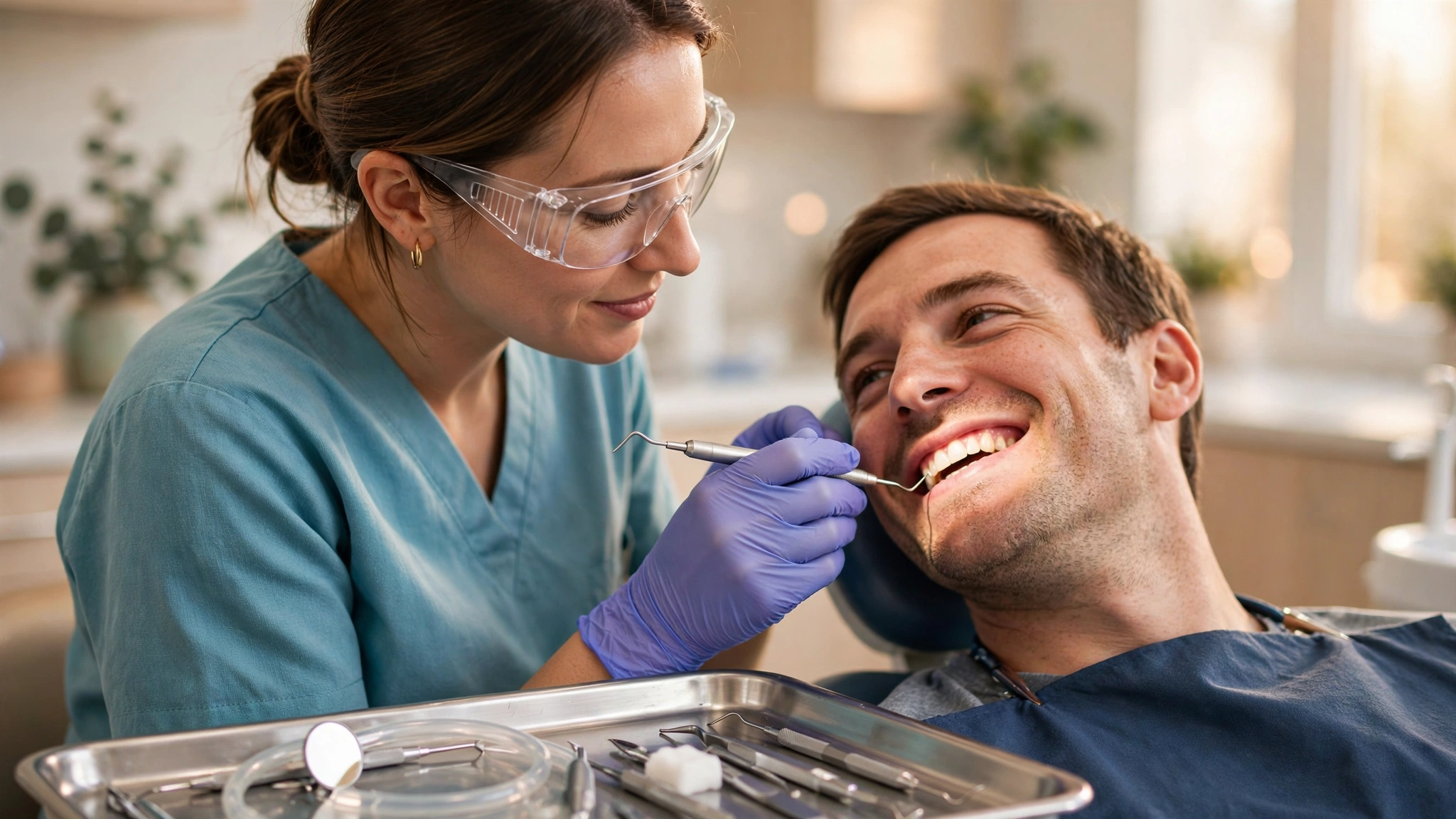
Sensitive teeth hurt because dentine is exposed. Enamel covers the crown and cementum covers the root; when either is lost, the porous dentine underneath opens. Cold, heat, acid or pressure moves fluid inside those tubules, and the nerve reads that movement as pain.
Dentine holds microscopic tubules that run toward the pulp, and that structure is why a lost surface layer matters so much. This is not the same as a cavity, and it is not the same as a cracked tooth. It is a specific problem with a specific set of causes, and the treatment follows from which cause you have.
Key facts
| Detail | |
|---|---|
| What hurts | Fluid moving inside open dentine tubules |
| Pooled estimate of how common | 11.5% of people, from a 2019 meta-analysis of 77 studies |
| Average across studies | 33.5%, because study methods vary widely |
| Main causes in adults | Gum recession, erosion, aggressive brushing, cracked teeth |
| Toothpaste actives with evidence | Stannous fluoride, potassium nitrate, arginine |
| What a dentist can add | Fluoride varnish, bonding over exposed dentine, a gum graft |
What is happening inside the tooth?
The mechanism is called the hydrodynamic theory, and it is still the main explanation. A 2021 review in the Journal of Endodontics by Aminoshariae and Kulild describes five proposed mechanisms and notes that they are not mutually exclusive: the classic hydrodynamic theory, direct innervation of the tubules, sensitisation of pain receptors, odontoblasts acting as sensors, and algoneurons.
For a patient, the practical part is the hydrodynamic one. Dentine tubules are roughly 1 to 2.5 micrometres across and they run from the surface toward the pulp. Cold, air, sweet and acid all change the pressure at the open end. The fluid shifts. The nerve ending at the other end fires.
Two things follow from that. First, anything that closes the tubules or blocks the nerve reduces the pain. Second, anything that keeps the tubules open — acid erosion, abrasive toothpaste, a hard brush — keeps the pain going.
The ADA's patient page on sensitive teeth lists the causes in plain language: tooth decay, fractured teeth, worn fillings, gum disease, worn tooth enamel and an exposed tooth root. It also states the mechanism directly — when dentine loses its protective covering, "these tubules allow heat and cold or acidic or sticky foods to reach the nerves and cells inside the tooth."
How common is it?
More common than most people assume, and the range in the literature is unusually wide.
A 2019 systematic review and meta-analysis by Favaro Zeola, Soares and Cunha-Cruz in the Journal of Dentistry pooled 65 papers reporting 77 studies. The prevalence in individual studies ranged from 1.3% to 92.1%. The pooled single estimate was 11.5% (95% CI 11.3%–11.7%), and the average across all studies was 33.5% (95% CI 30.2%–36.7%).
The authors were blunt about why the numbers disagree: the type of participants, the age range, how people were recruited and how many sites a study used all shifted the result. Higher figures came from studies of patients already in referral practices, younger adults and single-site convenience samples. In other words, a study run in a periodontal clinic finds more sensitivity than a survey of the general population, because it is looking at a group selected for gum problems.
Practical reading: somewhere between one in ten and one in three adults has this, and if you have gum recession you are closer to the higher number.
What causes sensitive teeth?
The causes are not interchangeable, and the treatment differs for each.
Gum recession. This is the commonest cause in adults. When the gum margin moves down the root, the cementum covering that root is thin — much thinner than enamel — and it wears away in months under a hard brush. What is left is exposed dentine. Sensitivity usually starts at the gum line and is worse on the side where you brush hardest, which is often the side you do not notice.
Our guide to receding gums covers why the gum moves and what can be done about it.
Erosion. Acid dissolves enamel. Dietary acid — citrus, soda, sports drinks, vinegar — and stomach acid from reflux both do it. Erosion thins the enamel until the dentine underneath is close enough to the surface to transmit. The tell is sensitivity that is worse after acidic food and a tooth surface that looks smooth, shiny and slightly yellow where the enamel has thinned.
Abrasion from brushing. A hard brush and heavy pressure remove enamel at the gum line and drive the gum back. This is the one cause entirely within your control.
Abfraction and cracked teeth. Biting force flexes a tooth at the neck, and over years that can chip enamel at the gum line. A cracked tooth produces sharp pain on release of biting rather than on cold alone. This needs an examination, not toothpaste.
Whitening and professional treatment. Sensitivity after bleaching is common and temporary. A 2016 systematic review and meta-analysis by de Geus and colleagues in Operative Dentistry compared at-home and in-office bleaching across 12 studies and found no significant difference in the risk or intensity of tooth sensitivity between the two methods, and no difference in effectiveness.
Gum disease. Advanced periodontal disease exposes roots as the attachment is lost. Sensitivity here is a symptom of the disease, not a standalone problem, and treating the sensitivity without treating the gum misses it.
Which toothpaste actually works?
This is where most advice is vague and the evidence is not. The actives are different and they do not all work the same way.
A 2023 systematic review and network meta-analysis by Pollard and colleagues in the Journal of Dentistry compared self-applied toothpastes across 32 randomised controlled trials and 4,638 participants. Its conclusion: twice-daily toothpaste containing stannous fluoride, potassium with or without stannous, or arginine can be recommended for reducing dentine hypersensitivity pain.
Note what is not on that list. A plain fluoride toothpaste with no desensitising active has not been shown to reduce dentine hypersensitivity pain, even though it prevents decay. If you have been using an ordinary paste and wondering why nothing changed, that is the reason.
Stannous fluoride. The strongest single body of evidence. A 2021 meta-analysis by West and colleagues in the Journal of Dentistry pooled 14 randomised trials with 1,287 participants. Stannous fluoride toothpaste gave a 57% benefit on evaporative air sensitivity and 142% benefit on tactile sensitivity versus negative controls. Against positive controls — potassium nitrate or arginine — it showed a 22% advantage on air sensitivity, significant at p = 0.036.
That last comparison matters, because it means stannous is not just better than nothing; it beat the two established actives on one measure. The same review found an 83% benefit against enamel erosion, which is a separate problem that often sits behind sensitivity.
Potassium nitrate. Works by raising the potassium concentration around the nerve and reducing its excitability. It takes longer to act than stannous and the effect fades if you stop. It is the active in most supermarket sensitive pastes.
Arginine. An amino acid that combines with calcium in saliva to plug open tubules. Good evidence, and often better tolerated in taste than stannous, which some people find metallic.
One honest limit on all three: the 2023 network meta-analysis noted that trial methodology in this field is not standardised, and called for guidelines. The direction of the evidence is consistent; the ranking between actives is softer than the marketing suggests.
What can a dentist do that toothpaste cannot?
Fluoride varnish. Applied in the chair, it strengthens the surface and reduces fluid movement. It helps most on exposed dentine and early erosion. At Paris Dental it is $45 per visit, and it is usually combined with a cleaning.
Bonding over exposed dentine. A resin sealant placed over the exposed root surface. Where the recession is shallow and the dentine is clean, this closes the tubules and covers the yellow root at the same time. This is tooth-coloured filling work, at $195 for one surface or $295 for several.
A gum graft. Where gum tissue has been lost, a graft covers the root and removes the exposure itself. The ADA lists this as one of the treatment options for sensitivity caused by lost gum tissue. It is a referral procedure at this practice.
Treating the cause. A cracked tooth, a leaking filling, a cavity at the gum line and periodontal disease all produce sensitivity, and none of them is fixed by desensitising paste. The NIDCR notes that as decay advances it can cause "tooth sensitivity to sweets, hot, or cold" — that sensitivity is a symptom, and the treatment is the filling, not the toothpaste.
Light therapy. A 2021 systematic review and meta-analysis by Shan and colleagues in Clinical Oral Investigations pooled 20 randomised trials and found low-level light therapy worked better than placebo for immediate, interim and persistent sensitivity. Against other desensitising strategies it showed no significant benefit except versus fluoride. It is a real option with modest evidence, not a first line.
How we approach it at Paris Dental
We start with the question of what is exposed and why, because that decides everything after it.
An examination checks the gum margin on every tooth, measures pocket depth where the gum looks inflamed, and looks for cracked enamel and leaking restorations. A radiograph is added when the sensitivity is on biting, is lingering, or sits under an old filling — those three point away from simple dentine exposure.
Then the answer is usually a sequence rather than a single product. Change the brush and the paste first, because that is free and it is what most people have not done. Add fluoride varnish if the dentine is exposed and clean. Seal a shallow exposed root if the appearance bothers you as well as the sensation. Refer for a graft if the recession is the driver and it is progressing.
What we do not do is treat sensitivity without looking. A patient who has been on sensitive toothpaste for a year and still hurts usually has a cracked tooth, a dead nerve or untreated gum disease, and each of those gets worse with time.
What does treatment cost in Temecula?
| Treatment | Fee | Unit |
|---|---|---|
| New-patient examination | $195 | per visit |
| Routine cleaning | $205 | per visit |
| Fluoride varnish | $45 | per visit |
| Tooth-coloured filling, one surface | $195 | per tooth |
| Tooth-coloured filling, multiple surfaces | $295 | per tooth |
| Deep cleaning | $195 | per quadrant |
| Periodontal maintenance | $295 | per visit |
| Intraoral radiograph | $25 | per image |
A realistic start for most adults is an examination at $195, a cleaning at $205 and a fluoride varnish at $45 — and the examination is the part that decides whether anything else is needed. Desensitising toothpaste is not a fee we charge; it is a purchase you make, and it is the cheapest step in the sequence.
If the cause turns out to be gum disease rather than exposure alone, the deep cleaning page sets out the per-quadrant cost and what it covers. Every fee is on the full treatment price list, and HSA or FSA funds can usually be used for all of it.
Results vary between patients. How much sensitivity improves depends on how much dentine is exposed, how long it has been exposed, and whether the cause has stopped.
When to call us
Call (951) 577-8090 if you have:
- Sensitivity that lasts more than a few seconds after the cold or heat is gone
- Pain that wakes you at night
- Sharp pain when you release a bite
- Sensitivity in one tooth only, especially under an old filling
- A tooth that has changed colour along with the sensitivity
- Gum that has visibly moved down a root, or a tooth that looks longer
- Sensitivity that has not improved after four weeks of desensitising toothpaste
Go to an emergency room or call 911 if you have facial swelling with fever, swelling that spreads toward the eye or neck, or difficulty swallowing or breathing.
Common questions
Is sensitivity a sign of weak enamel? Sometimes, but the more useful question is what exposed the dentine. Enamel can be thin from erosion, or intact while the gum has moved down the root. Those need different answers, and only one of them is about enamel strength.
Does calcium in toothpaste rebuild enamel? It can help remineralise a softened surface, and that is a real benefit for early erosion. It does not regrow lost enamel, and no product does. Our page on enamel erosion explains why.
Can I use sensitive toothpaste forever? Yes. There is no limit on duration for stannous fluoride, potassium nitrate or arginine pastes, and stopping usually brings the sensitivity back within weeks because the tubules reopen.
Why did my sensitivity start after a cleaning? A cleaning removes calculus that was covering an already-receded root. The dentine was exposed before; the deposit was hiding it. It usually settles in one to two weeks, and it is a sign the gum had receded rather than a sign the cleaning caused damage.
Does a night guard help? If you clench or grind, yes — grinding flexes teeth at the neck and wears enamel at the gum line. A guard does not treat sensitivity directly, but removing the force stops the cause progressing. A night guard is $395 per guard.
Is sensitivity after a filling normal? For a few days to a few weeks, yes, especially with a deep filling. Sensitivity that gets worse after two weeks, or that comes with pain on biting, means the bite is high or the nerve is inflamed, and it should be checked rather than waited out.
Sources
- Favaro Zeola L, Soares PV, Cunha-Cruz J. Prevalence of dentin hypersensitivity: systematic review and meta-analysis. Journal of Dentistry. 2019;81:1-6. https://pubmed.ncbi.nlm.nih.gov/30639724/
- Pollard AJ, Khan I, Davies M, Claydon N, West NX. Comparative efficacy of self-administered dentifrices for the management of dentine hypersensitivity — a systematic review and network meta-analysis. Journal of Dentistry. 2023;130:104433. https://pubmed.ncbi.nlm.nih.gov/36753794/
- Aminoshariae A, Kulild JC. Current concepts of dentinal hypersensitivity. Journal of Endodontics. 2021;47:1696-1702. https://pubmed.ncbi.nlm.nih.gov/34302871/
- West NX, He T, Zou Y, DiGennaro J, Biesbrock A, Davies M. Bioavailable gluconate chelated stannous fluoride toothpaste meta-analyses: effects on dentine hypersensitivity and enamel erosion. Journal of Dentistry. 2021;105:103566. https://pubmed.ncbi.nlm.nih.gov/33383100/
- de Geus JL, Wambier LM, Kossatz S, Loguercio AD, Reis A. At-home vs in-office bleaching: a systematic review and meta-analysis. Operative Dentistry. 2016;41:341-356. https://pubmed.ncbi.nlm.nih.gov/27045285/
- Shan Z, Ji J, McGrath C, Gu M, Yang Y. Effects of low-level light therapy on dentin hypersensitivity: a systematic review and meta-analysis. Clinical Oral Investigations. 2021;25:6571-6595. https://pubmed.ncbi.nlm.nih.gov/34642786/
- American Dental Association. Sensitive teeth. MouthHealthy. https://www.mouthhealthy.org/all-topics-a-z/sensitive-teeth
- National Institute of Dental and Craniofacial Research. Tooth decay. Reviewed September 2025. https://www.nidcr.nih.gov/health-info/tooth-decay
Results vary between patients. This article is general information and is not a substitute for an individual examination.
Book an examination
If cold hurts and you want to know whether it is exposed dentine, a cracked tooth or a nerve problem, an examination answers that in one visit. Call (951) 577-8090 or request a visit. We are at 31285 Temecula Pkwy Ste 205, Temecula, CA 92592, open Monday to Friday, 10:00 am to 5:00 pm. An online request is not a confirmed appointment.
If the sensitivity came with whitening, read how long whitening lasts or how to whiten at home. If your gum has moved down the root, read what gum disease does to the gum line and deep cleaning explained. If the enamel itself has worn thin, read why enamel cannot grow back.
Common questions
Why do my teeth hurt when I drink cold water?
Cold reaches the nerve through open tubules in exposed dentine. Enamel covers the crown and cementum covers the root; when either is lost, the dentine underneath is exposed. Dentine is porous, and fluid moving inside those pores triggers the nerve. The fix depends on why the dentine is exposed: recession, erosion, a cracked tooth or a lost filling are treated differently.
Does sensitive toothpaste actually work?
Some formulations do, and the evidence is specific rather than general. A 2023 network meta-analysis of 32 trials and 4,638 participants concluded that twice-daily toothpaste containing stannous fluoride, potassium with or without stannous, or arginine can be recommended for reducing dentine hypersensitivity pain. Plain fluoride toothpaste without one of those actives has not shown the same effect.
How long does sensitive toothpaste take to work?
Days to a few weeks, and it has to stay on the tooth. Most products are designed to be used twice daily in place of your normal paste, and some dentists suggest a small amount rubbed on the sensitive area rather than rinsed away immediately. If nothing changes after four weeks of consistent use, the cause is probably not simple dentine exposure.
Can sensitive teeth be a sign of something serious?
Sometimes. Sensitivity that is sharp, lasts more than a few seconds after the stimulus is gone, wakes you at night, or comes with pain on biting points to pulpitis, a cracked tooth or a dying nerve rather than simple dentine hypersensitivity. Those need an examination and often a radiograph, because the treatment is different and delay costs more.
Does whitening cause permanent sensitivity?
No. Whitening sensitivity is temporary and resolves after the course ends. A 2016 systematic review and meta-analysis of bleaching trials found no significant difference in the risk or intensity of tooth sensitivity between at-home and in-office bleaching. The sensitivity comes from peroxide reaching the pulp, and it settles once the peroxide stops.
Can receding gums cause sensitive teeth?
Yes, and it is one of the commonest causes in adults. When the gum moves down the root, the cementum covering the root is thin and wears away quickly, leaving dentine exposed. That is why sensitivity often starts at the gum line and why brushing hard makes it worse rather than better.
Will a fluoride varnish help?
It can, for exposed dentine and for early erosion. In-office fluoride strengthens the surface and reduces the movement of fluid in the tubules. It is not a fix for a cracked tooth or a cavity, and it does not replace treating the cause. At Paris Dental a fluoride varnish is $45 per visit.
Should I stop brushing the sensitive area?
No. Stopping lets plaque build up, and plaque drives both decay and gum inflammation, which cause more sensitivity. Switch to a soft brush, use light pressure, and use a desensitising paste. Brushing hard with a hard brush is what wears the enamel and pushes the gum back in the first place.