



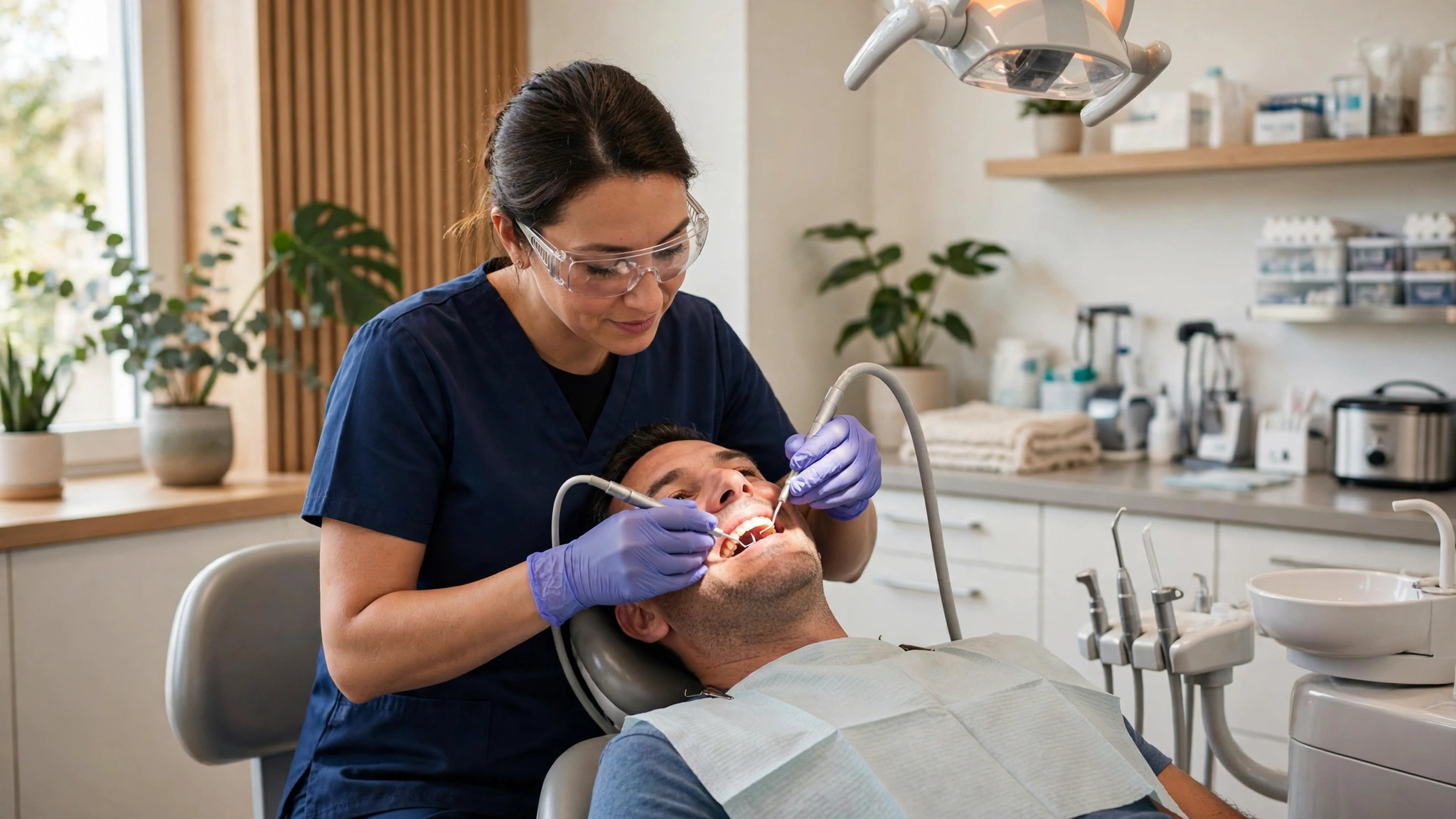
Periodontal maintenance is the ongoing care that follows treatment for gum disease, and it is not the same procedure as a routine cleaning. It is measured, recorded and repeated at an interval set by your own numbers rather than by a six-month habit.
The part most patients are never told: the three-month interval they are handed as a rule is not supported as a rule. A systematic review built to answer the question found the evidence for any single fixed interval weak. What the evidence does support is that attending maintenance at all changes outcomes — and that the alternative is measurable.
Key facts
| Detail | |
|---|---|
| What it is | Post-treatment care for a person with a history of periodontitis |
| CDT code | D4910 — distinct from D1110, an adult prophylaxis |
| What it includes | Pocket measurement, bleeding scores, above and below the gum line debridement, site-specific scaling |
| What sets the interval | Probing depths, bleeding on probing, smoking, diabetes, home care |
| Evidence for one fixed interval | Weak — no randomised trials comparing intervals were found |
| Typical starting range after treatment | 2 to 4 months for moderate to advanced disease |
| Effect of not attending | 26% higher risk of tooth loss in a meta-analysis of eight studies |
| Periodontal maintenance fee | $295 per visit |
Why the "once per periodontitis patient, always a periodontitis patient" line matters
The phrase sounds like a marketing slogan. It is a consensus position with a definition behind it.
The 2018 classification work that reorganised periodontal diagnosis states it plainly: "a periodontitis patient remains a periodontitis patient for life, even following successful therapy, and requires life-long supportive care to prevent recurrence of disease." The American Academy of Periodontology puts the reason in its own patient-facing FAQ: "A patient who has periodontitis remains at risk for further periodontal destruction even with treatment."
That has a practical consequence, and the AAP spells it out. A treated, stable patient "should not return to a level of evaluation and maintenance identical to a patient who has never had periodontitis (i.e., annual or semiannual exam/prophylaxis)."
So the choice in front of you after deep cleaning is not "maintenance or normal cleaning". It is "maintenance" or "less surveillance than your history calls for". Those are not the same thing, and the fee difference between them is where most of the confusion starts.
Did you know: the three-month interval came from a study where only 10% of patients got it
The three-month recall is quoted so often that it reads as a finding. Follow it back and it is a design decision.
The long-running Swedish programme that produced the 30-year tooth-mortality data assigned patients to intervals by their measured risk after the first six years of treatment. The paper describes what happened next: patients were "stratified into three subgroups, risk groups (R 1, R 2 and R 3)" and then "recalled in 'need-related' intervals; group R 1 (60% of subjects): once every 12 months; group R 2 (30% of subjects): once every 6 months; and group R 3 (10% of subjects): every 3 months."
Sixty percent of that cohort was seen once a year. Ten percent was seen every three months. The three-month figure is the interval for the highest-risk tenth, and it became the default advice for everyone.
What the systematic reviews actually found
Two reviews looked at the interval question directly, and both are careful in the same way.
The first pooled the maintenance recall literature and concluded: "Evidence for a specific recall interval (e.g. every 3 months) for all patients following periodontal therapy is weak." It also recorded that in the two studies that reported a mean interval for each group, significant tooth loss differences were noted as the interval neared the 12 month limit — a finding about the far end, not about three versus six.
The second review, in Periodontology 2000, agreed that the literature is heterogeneous and then gave the one usable steer: "In patients affected by moderate to advanced periodontitis, a supportive periodontal therapy protocol based on a 2-4 month recall interval appears reasonable." It also noted that a proportion of residual diseased sites is the thing worth using to set the frequency.
Neither review says three months is wrong. Both say the number is a starting range with a reason, not a law, and that the reason is your measurements.
Did you know: the general check-up interval has even less evidence behind it
It is worth separating two questions that get blended. One is how often a person with treated gum disease should be seen. The other is how often a healthy person should have a check-up.
The Cochrane review on recall intervals for general dental check-ups concluded: "There is no evidence to support or refute the practice of encouraging patients to attend for dental check-ups at six-monthly intervals." Its authors rated the available evidence as very low quality.
That does not mean skip check-ups. It means the six-month figure is a convention and should not be defended as a finding — and it should not be transplanted onto a patient with a gum disease history, whose interval is a different calculation.
The measurement that decides your interval
If one number predicts what happens to a treated tooth, it is the depth of the pocket left behind.
A cohort of 172 patients was followed for a mean of 11.3 years after active treatment. The result, comparing each pocket depth against a healthy depth of 3 mm or less:
| Residual pocket depth | Odds ratio for tooth loss, site level | Odds ratio, tooth level |
|---|---|---|
| 4 mm | 2.6 | 2.5 |
| 5 mm | 5.8 | 7.7 |
| 6 mm | 9.3 | 11.0 |
| 7 mm or more | 37.9 | 64.2 |
The authors' conclusion was not that maintenance should be more frequent. It was that "Residual PPD ≥6 mm represent an incomplete periodontal treatment outcome and require further therapy."
Read that again, because it changes what a maintenance visit is for. A 6 mm pocket that is still 6 mm at the next visit is not a maintenance problem to monitor. It is unfinished treatment, and the honest response is another course of therapy or a referral, not a shorter interval on the same procedure.
At patient level, the same study found that full-mouth bleeding of 30 percent or more and pockets of 6 mm or more were the risks for tooth loss — which is why bleeding is counted at every visit rather than glanced at.
What maintenance does, and does not, buy you
A meta-analysis of eight studies compared people who kept their maintenance appointments against those who did not. Non-compliers "have a 26% increased risk of tooth loss when compared with compliant patients (OR = 1.26; 95% CI = 1.06 to 1.51, Heterogeneity: I2 = 0%, p = 0.008)."
Two things about that figure are worth naming. The confidence interval is narrow and the heterogeneity is zero, which is unusually clean for this literature. And 1.26 is modest — it is a real effect, not a dramatic one. Maintenance lowers a risk; it does not remove it.
The same care is needed in the other direction. A review in Periodontology 2000 states that adherence "results in reduction of plaque and bleeding on probing, and potentially slowing down or halting the disease progression", and then says of the tooth-survival claim that a lack of randomised trials means "this last statement is still open to question." That sentence is the honest version. Every long-term maintenance study is observational, because nobody is going to randomise patients to neglect.
Did you know: most people quit maintenance in the first year
The strongest predictor of whether you will still be in maintenance in a decade is whether you are still in it in twelve months.
One review of adherence reports that of 637 patients who finished active treatment between 1983 and 1986, only 36% were compliant by the end of 1989, and that "most patients quit supportive periodontal treatment in the first year of maintenance care." A second cohort of 521 patients treated every three to five months showed that after 14 years, only 27.4% were in complete compliance.
It also found something worth knowing if you are choosing a dentist: among those patients, the more conservative the treatment, the better the compliance. People keep appointments for care they understand and can afford, which is an argument for a written plan and a published fee rather than a schedule handed over at the door.
Why the code changes, and why the claim may be denied
The procedure you receive after gum treatment has its own code, D4910, and the descriptor is specific: it is "instituted following periodontal therapy and continues at varying intervals, determined by the clinical evaluation of the dentist, for the life of the dentition or any implant replacements." It includes "site specific scaling and root planing where indicated."
That descriptor sets no time limit. Plans do. The ADA's own guidance on the code records that "some payers have limited this procedure to being paid as a benefit only within 2 to 12 months of SRP" and that "some payers have qualified periodontal maintenance by denying benefits for this procedure unless two or more quadrants have received prior therapy." It adds that most payers require a waiting period of 8 to 12 weeks after treatment.
The consequence is worth stating plainly, because it causes real friction at the front desk. "While the dentist is performing and reporting the correct procedure, benefits are denied solely because of the plan's limitations." And when the denial arrives with no explanation, "the patient may think that the dentist is incorrectly reporting or performing dental procedures."
What you can do: ask the plan for its processing policy for D4910 before treatment, ask us to send your periodontal charting with the claim so the payer can see the history, and treat the estimate as an estimate. A benefit quote is not a promise of payment.
One more thing the ADA notes, which surprises people: when a plan will not pay for maintenance, "many payers will allow payment for an adult prophylaxis, which is an integral component of the more global D4910." That is a partial payment for a lesser procedure. It is not the same visit, and it should not be described as one.
How we do it at Paris Dental
We measure, then we decide. Every maintenance visit records probing depths, recession, attachment level and bleeding on probing, site by site, and those numbers go into your record so the next visit can be compared with this one. A clean-looking gum that bleeds at 5 mm is not a stable gum, and the only way to know is to write the number down.
The interval comes from the chart, not from a card. A patient with pockets of 3 mm, no bleeding and no smoking history may be seen at a longer interval than one with residual 5 mm bleeding sites and diabetes. If your numbers improve for two visits, we will say so and move the interval out. That is the direction the evidence supports.
We treat what is still diseased. A residual pocket of 6 mm or more after active treatment gets re-treated or referred, not watched. Where surgical access or regeneration is needed, that work is done by a periodontist and we refer with the records already taken.
We put the fee in writing first. The fee for the visit, and anything we expect to add, is on the estimate before the appointment starts.
What it costs
| Treatment | Fee | Unit |
|---|---|---|
| New-patient examination | $195 | per visit |
| Periodontal maintenance | $295 | per visit |
| Deep cleaning | $195 | per quadrant |
| Routine cleaning (prophylaxis) | $205 | per visit |
| Intraoral radiograph | $25 | per film |
| Panoramic radiograph | $195 | per image |
| CBCT (3D scan) | $295 | per scan |
A full mouth of deep cleaning is four quadrants, so a complete course of active treatment is $780 at the published fee, before any additional procedures. A new-patient examination includes radiographs and a written plan.
Every fee on this page is on the full treatment price list, and you receive a written estimate before treatment begins. Results vary between patients: how much a pocket can be reduced, and how long stability holds, depend on the depth, the tooth, the bone left, smoking and home care.
When to call us
Call (951) 577-8090 if you have:
- Bleeding from the gums that has come back after treatment had settled it
- A tooth that has become loose, or has started to move
- Gums that are tender, swollen or discharging between visits
- Persistent bad breath that cleaning does not change
- Pain when biting on one tooth that was stable before
- A maintenance appointment you have postponed by more than a few months
Go to an emergency department rather than a dental appointment if there is facial swelling that is spreading toward the eye or throat, swelling with fever or difficulty swallowing or breathing, or bleeding that does not stop with ten minutes of firm pressure. Those are not gum-maintenance problems.
Common questions
Is maintenance painful? The visit is usually comfortable, and where pockets are deep or roots are sensitive we use local anaesthetic. Some tenderness for a day or two afterwards is common and settles.
Can the interval get shorter instead of longer? Yes, and it should when the numbers move the wrong way. New bleeding at 5 mm, a new 6 mm pocket, a change in medication or a new diagnosis of diabetes are all reasons to bring the next visit forward.
Does smoking change the interval? It changes the reading as well as the risk. Smoking suppresses bleeding, so the gum can look healthier than it is, and the same review evidence lists smoking as a risk for recurrence. We rely on probing depths and attachment levels rather than appearance in anyone who smokes.
Are implants maintained the same way? The principle is the same and the code is the same — the descriptor covers implant replacements. Peri-implant pockets are measured and bleeding is checked, because bone loss around an implant is usually silent until it is advanced.
What if I have not been for years? Nothing is decided at the door. You are examined, measured and given a written plan with the options in order of what matters most. Some patients need active treatment again; some need maintenance only.
Does insurance cover the visit? Many PPO plans pay part of it, and the amount depends on your plan, your annual maximum and whether the payer recognises your prior treatment history. We check benefits before treatment and tell you the estimated share.
Sources
- Farooqi OA, Wehler CJ, Gibson G, Jurasic MM, Jones JA. Appropriate Recall Interval for Periodontal Maintenance: A Systematic Review. Journal of Evidence Based Dental Practice. 2015;15(4):171-181. PMID 26698003. https://pubmed.ncbi.nlm.nih.gov/26698003/
- Trombelli L, Simonelli A, Franceschetti G, Maietti E, Farina R. What periodontal recall interval is supported by evidence? Periodontology 2000. 2020;84(1):124-133. PMID 32844410. https://pubmed.ncbi.nlm.nih.gov/32844410/
- Matuliene G, Pjetursson BE, Salvi GE, Schmidlin K, Brägger U, Zwahlen M, Lang NP. Influence of residual pockets on progression of periodontitis and tooth loss: results after 11 years of maintenance. Journal of Clinical Periodontology. 2008;35(8):685-695. PMID 18549447. https://pubmed.ncbi.nlm.nih.gov/18549447/
- Axelsson P, Nyström B, Lindhe J. The long-term effect of a plaque control program on tooth mortality, caries and periodontal disease in adults. Results after 30 years of maintenance. Journal of Clinical Periodontology. 2004;31(9):749-757. PMID 15312097. https://pubmed.ncbi.nlm.nih.gov/15312097/
- Campos IS de O, et al. The Effects of Patient Compliance in Supportive Periodontal Therapy on Tooth Loss: A systematic Review and Meta-analysis. Journal of the International Academy of Periodontology. 2021. PMID 33512339. https://pubmed.ncbi.nlm.nih.gov/33512339/
- Echeverría JJ, Echeverría A, Caffesse RG. Adherence to supportive periodontal treatment. Periodontology 2000. 2019;79(1):200-209. PMID 30892763. https://pubmed.ncbi.nlm.nih.gov/30892763/
- American Dental Association. D4910 Coding for Periodontal Maintenance. https://www.ada.org/resources/practice/dental-insurance/d4910-coding-for-periodontal-maintenance
- American Academy of Periodontology. Frequently Asked Questions on the 2018 Classification of Periodontal and Peri-Implant Diseases and Conditions. https://www.ada.org/-/media/project/ada-organization/ada/ada-org/files/jcnde/perio_disease_classification_faq.pdf
- Caton JG, Armitage G, Berglundh T, et al. A new classification scheme for periodontal and peri-implant diseases and conditions. Journal of Periodontology. 2018;89(Suppl 1):S1-S8. https://aap.onlinelibrary.wiley.com/doi/full/10.1002/JPER.18-0157
- Riley P, Worthington HV, Clarkson JE, Beirne PV. Recall intervals for oral health in primary care patients. Cochrane Database of Systematic Reviews. 2013;12:CD004346. PMID 24353242. https://pubmed.ncbi.nlm.nih.gov/24353242/
Results vary between patients. This article is general information and is not a substitute for an individual examination.
Keep the chart, not the habit
If you have finished gum treatment, the useful question is not "when am I due" but "what were my numbers last time". Bring the estimate, bring the chart, and ask for the depths site by site. Call (951) 577-8090 or request a visit. We are at 31285 Temecula Pkwy Ste 205, Temecula, CA 92592, open Monday to Friday, 10:00 am to 5:00 pm. An online request is not a confirmed appointment.
If you have not had active treatment yet, deep cleaning explained covers what that course involves and why it comes first. Receding gums covers what happens when the tissue is already gone, and gum disease and diabetes covers the one systemic condition that changes the interval most. If a claim has been denied, how to read a dental EOB explains the code on the page in front of you.
Common questions
Is periodontal maintenance the same as a regular cleaning?
No. A routine cleaning removes plaque and calculus from above the gum line on a person without a history of gum disease. Periodontal maintenance goes below the gum line, includes site-specific scaling and root planing where the measurements call for it, and is a follow-up to treatment you have already had. The CDT code is different, D4910 rather than D1110, and the fee is different.
Do I have to go every three months forever?
No, and nothing in the evidence says you do. A systematic review of the recall literature concluded that evidence for a specific interval such as every three months is weak. In the 30-year Swedish study that the three-month habit is usually traced to, only 10 percent of the patients were assigned to three months; 60 percent were seen once a year. The interval should follow your probing depths, bleeding scores and risk factors, and it can lengthen.
Why does insurance deny periodontal maintenance?
Usually because of the plan, not the procedure. The ADA notes that some payers pay for periodontal maintenance only within 2 to 12 months of active treatment, and some require two or more quadrants to have been treated first. The CDT descriptor sets no time limit. Ask for the plan's processing policy in writing, and ask us to send your periodontal charting with the claim.
How much does periodontal maintenance cost in Temecula?
At Paris Dental a periodontal maintenance visit is $295. A new-patient examination is $195 and includes radiographs and a written plan. A deep cleaning, if you have not had active treatment yet, is $195 per quadrant. Every fee is on the published price list, and you receive a written estimate before treatment begins.
What actually happens at a maintenance visit?
Your gum pockets are measured and recorded, bleeding sites are counted, and the deposits above and below the gum line are removed, with extra scaling at the sites that need it. It is not a polish and a rinse. The measurements are the point, because they are what shows whether the disease is stable or moving.
Can I go back to normal cleanings if my gums are fine now?
The American Academy of Periodontology is direct about this. A patient who has had periodontitis remains at risk even with treatment, and should not return to the same level of maintenance as someone who never had it. Shallow, non-bleeding pockets may mean a lower frequency, not a different procedure.
What if I stop going?
The numbers are not subtle. A meta-analysis of eight studies found that people who did not keep maintenance appointments had a 26 percent higher risk of losing teeth. Residual pockets of 6 mm or more carried an odds ratio for tooth loss of 11.0 at tooth level. Most of the harm happens quietly, before anything hurts.