



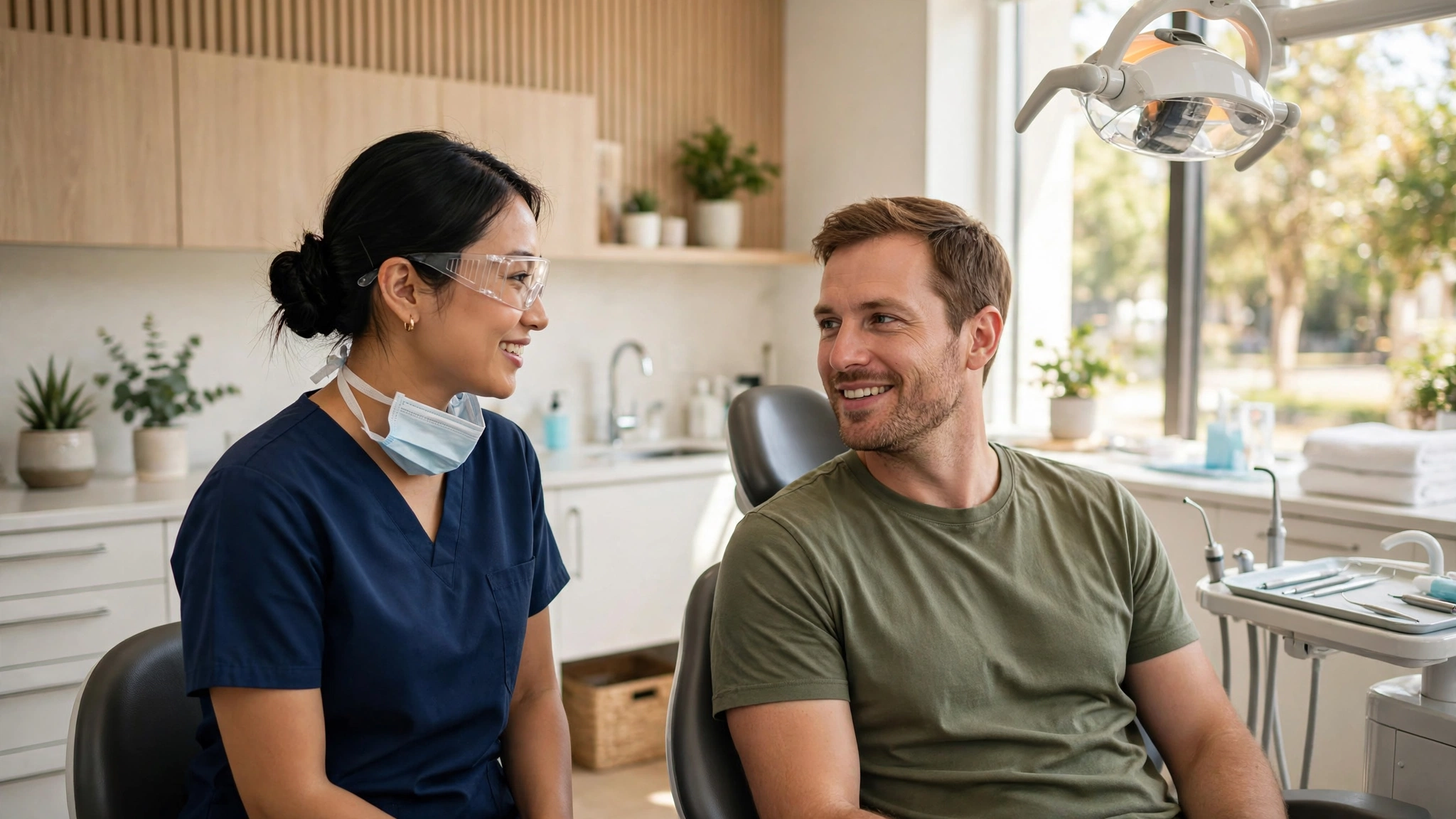
A second opinion is a fresh examination and a new written plan, made by a dentist who has no stake in the answer. Bring your x-rays and your old estimate, ask what happens if you wait, and expect the two plans to differ in places — that is normal, not proof of bad faith.
Most people who ask for one are not suspicious. They have been quoted a number that felt large, or a plan that felt vague, and they want a second set of eyes before they commit money they do not have spare.
That is a reasonable thing to want. This page explains what a second opinion is, how much dentists genuinely disagree, what to bring, what your rights are over your own records, and the questions that separate a useful opinion from a sales call.
Key facts
| Detail | |
|---|---|
| What it is | A separate examination and a written plan, not a review of a photograph |
| What to bring | The written plan, the estimate, and the x-ray files themselves |
| Consultation and treatment plan | $195 per visit |
| Your right to records | Federal law gives you copies; normally within 30 days |
| Agreement on treating a tooth, 1993 study | Only 22% of recommended teeth got a unanimous vote |
| Crown disagreement, 2016 study | 98% would not crown a small filling; 97% would crown the largest |
| Unnecessary filling rate, 2020 experiment | 28% of 180 dentists recommended a filling that was not needed |
What a second opinion actually is
Two different things get called a second opinion, and only one of them is worth paying for.
The weak version is a conversation. You describe the plan, someone nods, and you leave with an opinion about a description. Nobody looked at your mouth. That is cheap and close to worthless.
The strong version is an examination. Someone looks at your teeth and gums, reads your x-rays, charts what is actually there, and writes down their own plan with their own fees. Then you can put the two plans side by side and see where they differ.
The difference matters because the American Dental Association's code of ethics is explicit about the point of the exercise. Advisory Opinion 2.B.1 says a dentist giving a second opinion "should not have a vested interest in the ensuing recommendation." In plain terms: the person judging the plan should not profit from the judgement.
That is a hard standard to meet in a free appointment offered by a practice that would like your case. It is not impossible — plenty of offices offer an honest free look. But you should know what you are accepting.
Did you know? The same ethics code advises dentists to suggest a second opinion themselves, "especially when they have questions or concerns about the appropriateness of the recommended treatment." Asking is not an accusation. The profession's own rules treat it as ordinary.
How often two dentists really disagree
This is the part patients never hear, and it is the reason a second look is worth the fee.
A study by Bader and Shugars in the Journal of Dental Research had an average of 6.6 general dentists examine each of 1,187 teeth across 43 patients. Overall agreement was moderate. Agreement was fair on unrestored teeth. It was lowest on teeth that already had fillings, because a filling edge can be read as a problem by one dentist and as a stable margin by another.
The number that stops people: among every tooth that at least one dentist recommended treating, only 22% received a unanimous recommendation.
Read that carefully. It does not mean dentists are careless. It means that the point at which a tooth crosses from "watch it" to "treat it" is genuinely a judgement, and different trained people draw the line in different places.
A 2016 study from the National Dental Practice-Based Research Network, published in JADA, found the same shape in crowns. Of 2,132 eligible dentists, 1,777 replied. Agreement was strong where the case is clear: 94% would crown a back tooth that had a root canal. Agreement collapsed where the case is a judgement call. Shown a small filling, 98% said they would not recommend a crown. Shown the largest restoration in the set, 97% said they would.
So most disagreements are not about the obvious things. They are about the middle — the tooth that could be watched, could be repaired, or could be crowned.
Did you know? That 2016 study also found that the likelihood of recommending a crown was associated with factors that have nothing to do with the tooth: whether the dentist owned the practice, how busy the practice was, the region of the country, and whether the patient had insurance. The authors put it plainly — recommendations "may be influenced by factors unrelated to tooth and patient variables."
The uncomfortable number
There is also direct evidence that unnecessary treatment happens, and it is better to say so than to pretend otherwise.
A field experiment published in The Economic Journal in 2020 sent one test patient to 180 dentists. The patient had a shallow cavity limited to the outer enamel — a lesion that guidelines say should be watched, not drilled. Four independent reference dentists agreed it needed no filling.
28% of the 180 dentists recommended at least one filling. The suggested number ranged from one to six fillings in a single mouth. Across the whole experiment, 13 different teeth were named for treatment.
The authors also tested something patients wonder about: does saying "I am getting a second opinion" change the advice? It did not reduce overtreatment to a statistically significant degree. Announcing a second opinion is not a shield.
The honest conclusion is not "dentists overtreat." It is narrower and more useful: for borderline findings, a meaningful minority of dentists will treat, and you cannot tell which one you are sitting in front of. That is the case for a second look on anything expensive, and for asking what happens if you wait.
What to bring, and what to ask for
Ask the first office for three things, in writing:
- The written treatment plan, itemised by tooth and by procedure. Not a single total.
- The x-ray files themselves — the digital images, not a printout and not a photo of a screen.
- The estimate, showing what your insurance is expected to pay and what you are expected to pay.
If the plan is one line that says "full mouth rehabilitation" with a total at the bottom, you have been given a price, not a plan. Ask for the itemised version before you ask anyone else for an opinion. A second dentist cannot check a number that has no parts.
Bring your own list too. Current medications, medical conditions, and what actually bothers you. A second opinion formed without knowing that you take a blood thinner or that you have not slept for a week from the pain is a thin opinion.
You are allowed to have your records
Some patients are told, or simply assume, that x-rays belong to the dentist who took them. They do not, in the way that matters.
The federal HIPAA Privacy Rule gives you the right to see and get copies of your health information, and that includes dental images and notes. A practice normally has up to 30 days to provide them, and often provides them much sooner. It may charge a reasonable fee for copies. It cannot refuse because you owe money on a bill.
The ADA's own ethics code adds a professional duty on top: dentists are obliged to safeguard records, and section 1.B.1 addresses furnishing copies. A refusal to hand over recent x-rays is a real signal, and a rare one.
What to ask the second dentist
The questions do most of the work. Ask these, and listen for whether the answers are specific.
What do you see? Ask them to point at the tooth on the image and describe it. Vague answers to a specific question are the thing to notice.
What happens if I wait six months? Some things cannot wait: an active infection, a cracked tooth that is moving, a spreading swelling. Others can be watched with a photograph and a date. A dentist who says "everything can wait" is as unhelpful as one who says "nothing can."
What is the smallest version of this treatment that solves the problem? A repair instead of a replacement, a filling instead of a crown, one tooth instead of six. Not every case has a smaller version, but the question reveals how the plan was built.
What would make you change your mind? A good clinician can name the finding that would move them. That answer tells you they are reasoning from evidence rather than habit.
What does it cost, itemised, and what is not included? Ask about the graft, the sedation, the build-up, the retainer, the second visit. The line items that appear later are usually the ones nobody mentioned.
What is your own experience with this? A general dentist can do a great deal. Some cases are better referred, and a dentist who says so is being straight with you.
When a second opinion is worth the appointment
Worth it:
- Any plan that involves implants, a full-arch prosthesis, or more than four crowns
- Any plan that removes teeth that are not causing you pain
- A gum treatment plan where the number of quadrants or visits seems large
- A quote that arrived without an itemised written plan
- A recommendation to replace fillings that are not bothering you
- Anything you have been asked to decide on the same day
Not worth it:
- A single small filling in a tooth that hurts, where the finding is obvious
- An emergency with swelling or a fever — that needs care now, not a comparison
- A cleaning schedule you already understand
Worth moving fast on instead: facial swelling, a fever with tooth pain, a tooth knocked loose, bleeding you cannot stop, or trouble swallowing or breathing. Those are not second-opinion problems.
Did you know? Doing nothing is a real option in some cases, and it deserves a real answer. A shallow cavity in enamel can often be watched with fluoride and a shorter recall. A deep cavity cannot. The useful question is never "should I treat this" in the abstract — it is "what happens to this specific tooth if I do not."
How we do it at Paris Dental
We write the plan down, by tooth. A consultation here includes a full examination, radiographs and a written plan at $195. You leave with the document. If you take it to another office, that is your business and we will not ask why.
We show you the image. If a tooth needs work, you will see the tooth on the screen and hear which part is the problem. You are allowed to disagree with what you are looking at, and to ask what else it could be.
We say when the answer is "wait." Monitoring a small lesion with a date to re-check is a legitimate plan and we write it down as one. It is not a way of avoiding work; it is the correct answer for a lot of early findings.
We hand over records without friction. Ask at the front desk and we will send your images and notes to the office you name. There is no fee for that request in the ordinary case.
We do not run down the other dentist. The ADA code asks that patients be told about their oral health "without disparaging comment about prior services." If we think a plan was too aggressive, we will say what we would do differently and why, not what kind of person would have suggested it.
Results vary between patients. Two honest dentists can look at the same tooth and reach different conclusions, and the right choice depends on your symptoms, your other teeth, your health and what you can afford.
What it costs
| Treatment | Fee | Unit |
|---|---|---|
| Consultation and treatment plan | $195 | per visit |
| New-patient examination | $195 | per visit |
| Panoramic radiograph | $195 | per image |
| Intraoral radiograph | $25 | per film |
| CBCT (3D scan) | $295 | per scan |
| Same-day CEREC crown | $1,295 | per tooth |
| Laboratory crown (porcelain or zirconia) | $1,295 | per tooth |
| Tooth-coloured filling (one surface) | $195 | per tooth |
| Tooth-coloured filling (multiple surfaces) | $295 | per tooth |
| Root canal treatment (molar) | $995 | per tooth |
| Dental implant (surgical placement) | $1,895 | per implant |
| Complete single-tooth implant (implant, abutment and crown) | $4,085 | per tooth |
| Simple extraction | $295 | per tooth |
A full examination with radiographs and a written plan is $195. That is the cost of a second opinion here, and it is the same fee whether or not you choose us for the treatment.
If you already have recent images, bring them and it may be less. Every fee is on the full treatment price list. HSA and FSA funds can usually be used for the examination and for treatment.
When to call us
Call (951) 577-8090 if:
- A tooth is painful enough to wake you
- You have facial swelling, with or without a fever
- A tooth has cracked and a piece is moving
- Bleeding after an extraction has not settled after 30 minutes of firm pressure
Go to an emergency department for swelling that is closing your eye or spreading down your neck, for trouble swallowing or breathing, for a fever with a rapid heartbeat, or for a head injury that involved a tooth. Those need hospital care, not a second opinion.
Common questions
How long does a second opinion take? About 45 minutes here, including the examination, the images and the conversation. If your records arrive ahead of the appointment, it moves faster.
Will you tell me if the first plan was wrong? We will tell you what we see and what we would do. Usually that is not "wrong," it is "different," and the useful part is the reasoning. Where a plan was clearly excessive we say so plainly, without guessing at motives.
Can I get a second opinion on just one tooth? Yes, and it is the most common request. Bring the whole plan anyway, because one tooth rarely sits alone.
Do I have to tell you who the first dentist was? No. If you want to avoid anchoring, say nothing about the first opinion and let this examination stand on its own. That is a reasonable way to use the appointment.
What if both dentists agree? Then you have bought certainty for $195, which is cheaper than most uncertainties in dentistry. You can proceed with the plan, or ask for it to be staged.
What if I cannot afford either plan right now? Say so at the appointment. A plan can often be sequenced — the urgent tooth first, the elective work later — and knowing your limit changes what gets written down. Paying for dental work covers the funding side.
Is a second opinion covered by insurance? Sometimes as a consultation, often not. Ask your plan whether a diagnostic consultation is a covered benefit. The examination fee here is published, so you know the worst case before you book.
Sources
- American Dental Association. Principles of Ethics and Code of Professional Conduct — Nonmaleficence, Advisory Opinion 2.B.1 Second Opinions. https://www.ada.org/about/principles/code-of-ethics/nonmaleficence
- Bader JD, Shugars DA. Agreement among dentists' recommendations for restorative treatment. Journal of Dental Research. 1993;72(5):891-896. https://pubmed.ncbi.nlm.nih.gov/8501287
- McCracken MS, Louis DR, Litaker MS, et al. Treatment recommendations for single-unit crowns: findings from the National Dental Practice-Based Research Network. Journal of the American Dental Association. 2016;147(11):882-890. https://pubmed.ncbi.nlm.nih.gov/27492046
- Gottschalk F, Mimra W, Waibel C. Health services as credence goods: a field experiment. The Economic Journal. 2020;130(629):1346-1383. https://doi.org/10.1093/ej/ueaa024
- Wentworth RB. Are advertisements that offer "free second opinions" ethical? Journal of the American Dental Association. 2011;142(10):1199-1200. https://pubmed.ncbi.nlm.nih.gov/21965496
- U.S. Department of Health and Human Services. Your right to access your health information. https://www.hhs.gov/hipaa/for-individuals/right-to-access/index.html
- American Dental Association. Principles of Ethics and Code of Professional Conduct — Patient Records, section 1.B. https://www.ada.org/about/principles/code-of-ethics
Results vary between patients. This article is general information and is not a substitute for an examination, and it is not a comment on any other dentist's care.
Book a second look
Bring the plan and the x-rays. We will look at your mouth, show you what we see, and write our own plan down.
Call (951) 577-8090 or request a visit. We are at 31285 Temecula Pkwy Ste 205, Temecula, CA 92592, open Monday to Friday, 10:00 am to 5:00 pm. An online request is not a confirmed appointment.
If you already know the work is needed and the question is how to pay for it, dental insurance and financing explains benefit checks and written estimates. If the first plan involved a crown you are unsure about, what a dental crown is covers what the treatment does and does not fix.
Common questions
How do I ask for a second opinion without upsetting my dentist?
Say it plainly and early: you want time to think, and you would like a copy of your x-rays and the written plan. You do not owe anyone an apology for this. The American Dental Association's code of ethics says a dentist giving a second opinion should not have a vested interest in the answer, which is exactly why the request is normal.
Can my dentist refuse to give me my x-rays?
Under the federal HIPAA Privacy Rule you have the right to see and get copies of your health information, including dental x-rays and notes. A practice normally has up to 30 days, and often provides them far sooner. It may charge a reasonable fee for copies. It cannot refuse because of an unpaid bill.
What should a second opinion cost?
At this office an examination with a radiograph and a written plan is $195. Some offices charge nothing and treat the visit as a way to win you as a patient, which is legal but worth noticing. A free opinion from someone who wants your case is not automatically neutral.
Do I need new x-rays for a second opinion?
Usually not, if yours are recent and readable. Ask the first office for the images themselves, not a printout. If the images are older than a year or two, or if you have new symptoms, some new imaging may be needed. Ask why before it is taken.
How often do two dentists disagree about the same tooth?
More often than most patients expect. In a study of 1,187 teeth examined by an average of 6.6 dentists each, only 22% of the teeth that someone recommended treating got a unanimous vote. Agreement was weakest on teeth that already had fillings.
Is it rude to get a second opinion after a diagnosis?
No. The American Dental Association's ethics code advises dentists to suggest a second opinion when a patient has doubts about whether treatment is appropriate. Asking for one is a normal part of deciding about your own mouth.
What if the second dentist disagrees with the first?
You will hear two reasons, not two verdicts. Ask each one what they see, what happens if you wait, and what happens if you do nothing. Then choose the plan whose reasoning you can follow. A disagreement is information, not a scandal.