



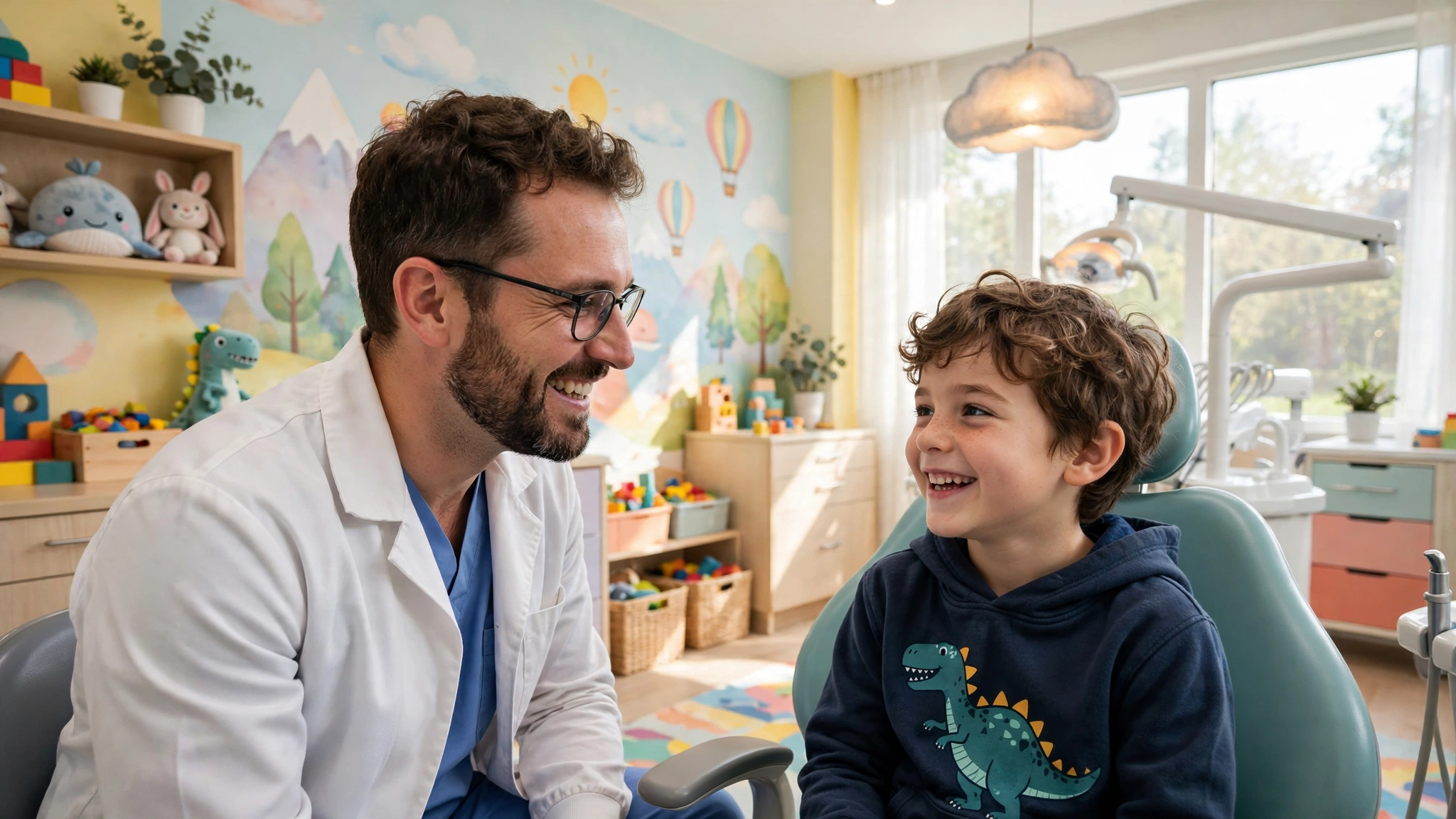
Most autistic children can be treated in a general dental office. The difference is not the treatment; it is the pace, the room and the number of visits. A 2017 study of 168 autistic children found that 77.4% reached a seated dental examination within one or two visits, and 87.5% within five or less.
That number is the most useful thing in this article, because it replaces a fear with a schedule. The fear is that a child who will not open their mouth will never be examined. The evidence says most are examined, and it says the route there is a series of short visits, not one long one.
The second most useful thing is what the room does. In the largest randomized trial of its kind, changing the sensory environment alone, with no change to the procedure, lowered measured physiological stress in autistic children.
Key facts
| Detail | |
|---|---|
| Autistic 8-year-olds identified in California | About 1 in 19, the highest of 16 CDC sites |
| Pooled caries prevalence in autism | 60.6% in a seven-study meta-analysis |
| Pooled periodontal disease prevalence | 69.4%, from three studies |
| Seated examination within 1–2 visits | 77.4% of 168 children |
| Within 5 visits or less | 87.5% |
| Effect on physiological stress in an adapted room | Skin conductance 1.22 μS lower |
| Effect on behaviour ratings | Better, but not statistically significant |
| Certainty of the sensory evidence | Moderate, not high |
How common it is here, and why the local number matters
The CDC's Autism and Developmental Disabilities Monitoring Network reported that among 8-year-old children across its 16 sites in 2022, about 1 in 31, or 3.2%, were identified with autism. The range between sites was enormous: 1 in 103 in Texas-Laredo to 1 in 19 in California.
Temecula is in California, and Riverside County is inside the state surveillance picture. That means a general dental practice in this city sees autistic children constantly, whether or not the schedule says so, and whether or not the child has a diagnosis recorded.
The CDC is careful about what the variation means: "currently, research does not show that living in certain communities puts children at greater risk for developing ASD," and the differences are likely due to evaluation and testing practices. That is the honest reading. It still leaves the practical fact, which is that this is not a rare patient in this town.
Did you know: the mouth is often worse, and the reason is mechanical
There is a persistent assumption that autistic children have fewer cavities, usually explained by restricted diets. The pooled evidence does not support the comforting version of that story.
A systematic review and meta-analysis in the International Journal of Paediatric Dentistry, led by da Silva, pooled seven studies and found a caries prevalence of 60.6% (95% CI 44.0 to 75.1) and a periodontal disease prevalence of 69.4% (95% CI 47.6 to 85.0) in children and young adults with autism.
A 2025 meta-analysis in the same journal went further and asked a sharper question: not "is there more decay" but "how much". That review found no significant difference in the number of decayed teeth, in DMFT or in dmft between autistic and non-autistic people. What it did find was a significantly higher DMFS — the measure that counts surfaces rather than teeth — with a mean difference of 2.33 (95% CI 0.56 to 4.10).
Read together, those two findings say something specific. It is not that autistic children get more cavities. It is that when decay happens, it spreads across more of the tooth before it is caught. The authors' own interpretation is that progression is faster, "strongly associated with a lack of qualified care or even the absence of it."
That is a scheduling problem, not a brushing problem. A child seen once every two years will have larger lesions than a child seen twice a year, whatever happens at the sink.
What the sensory evidence shows, and what it does not
This is the part where most dental websites overclaim, so it is worth setting out precisely.
The largest trial. Stein Duker and colleagues published a randomized crossover trial in JAMA Network Open in 2023. One hundred and sixty-two autistic children aged 6 to 12, each of whom had one cleaning in a sensory-adapted dental environment and one in a regular environment, in randomized order about six months apart. The primary outcome was electrodermal activity — skin conductance, a physiological measure of sympathetic arousal that a child cannot fake or please an adult with.
The result: children had significantly lower physiological stress in the adapted room, with a mean difference in skin conductance level of −1.22 μS (95% CI −2.17 to −0.27). The trial reports no participants withdrawing because of adverse effects.
The behavioural results were more mixed, and the paper says so. Video-coded frequency and duration of distress were significantly lower, with effect sizes from −0.84 to −1.19. But the questionnaire measures of behavioural distress — the Frankl Scale, the Anxiety and Cooperation Scale, the CDBRS — showed no significant difference.
The meta-analysis. A 2023 systematic review and meta-analysis in BMC Oral Health pooled the crossover trials. For physiological outcomes the pooled standardized mean change was −0.66 (95% CI −1.01 to −0.30, p < 0.001) with no heterogeneity. For behaviour, the pooled result was 0.51 (95% CI −0.20 to 1.21, p = 0.161) — not statistically significant, with substantial heterogeneity.
That same review is candid about study quality: four of the five included studies were rated at high risk of bias, largely because blinding a room is impossible.
The professional guidance. The American Academy of Pediatric Dentistry's 2023 clinical practice guideline on nonpharmacological behaviour guidance reviewed the evidence and concluded that for children and adolescents with special health care needs, "audiovisual distraction and sensory-adapted dental environment showed large reduction of anxiety." It also states that all its recommendations are conditional and "mostly based on very low certainty of evidence."
So the honest summary is this. The physiological effect is real and replicated. The behavioural effect is plausible and inconsistent. Nothing in the evidence supports a claim that an adapted room makes dental care easy. What it supports is that the room is one of the few things a practice can change unilaterally, at low risk, that measurably lowers a child's stress.
That is worth doing even though it is not a cure for anything.
Did you know: what "sensory-adapted" actually means in practice
The term sounds vague. The published descriptions are concrete, and the AAPD's behaviour guidance document lists the components: dimmed lighting, moving projections such as fish or bubbles on the ceiling, soothing background music, and "application of wrap/blanket around the child to provide deep pressure input."
Notice what is not on that list. There is no special equipment and no drug. It is light, sound, what the child looks at, and what is touching them.
The AAPD document also records the contraindications for a sensory-adapted environment, and the entry is "None."
Two more details from the trial design are worth knowing, because they explain why the room alone is not the whole answer. The trial's own analysis found that age, IQ and expressive communication moderated how much the adapted room helped. A younger child with more expressive language benefited differently from an older child with less. And the room did not change the procedure at all: same cleaning, same instruments, same sequence.
The room lowers the load. It does not teach the child anything. That is what the visits are for.
The visit that is not a treatment visit
Desensitization is the unglamorous technique with the strongest evidence behind it, and its logic is simple: a child tolerates what they have already experienced, in small enough steps that no step is frightening.
A 2017 retrospective study in the Journal of the American Dental Association, led by Nelson, reviewed 168 autistic children who attended a university dental desensitization program. The outcome measured was a minimal threshold examination — a real examination, seated in a dental chair. The results:
- 77.4% reached it within one to two visits.
- 87.5% reached it within five visits or less.
The study also identified which children were more likely to succeed: those able to take part in group activities (relative risk 1.18), able to communicate verbally (1.17), able to understand most language (1.14), rated by their caregiver as having moderate rather than severe autism (1.24), and able to dress themselves (1.27). Those are predictors, not verdicts. Plenty of children outside those categories still reached the examination.
The steps themselves, described in Nelson's 2015 review of behavioural approaches, are the ones the NIDCR has published for years: talk to the caregiver about what the child tolerates, use tell-show-do, divide the appointment into small parts, use stories or video modelling before the visit, and modify the environment to reduce sensory triggers.
At the chair, the sequence that works is deliberately anticlimactic. Sit in the room. Sit on the stool. Sit in the chair. Look in the mirror. Count the teeth with a finger. Then a toothbrush. Then the examination. Each step ends while it is still going well.
How we do it at Paris Dental
We book the first visit short and we tell you it is short. Twenty minutes, no treatment planned, no instruments on the tray unless the examination gets that far. If your child leaves calm after five minutes, that visit did its job and the next one starts from a better place.
We ask you what to change before we meet your child. Sound, light, smell, touch, the order of the room, whether the door stays open, whether you sit beside them or hold a hand. You know the answers and we do not. A sentence from you saves three visits.
We use the words your family uses. If the toothbrush is called something else at home, we use that word. If your child uses picture cards or a communication device, bring it and we will use it.
We keep the same room, the same chair and the same people where we can. Consistency is one of the few things the reviews agree on, and it costs nothing to arrange.
We examine what we can and write down what we could not. A partial examination with an honest record is more useful than a complete one bought at a cost. The record tells the next visit where to start.
We tell you early if a child needs more than we can give. Nitrous oxide and oral sedation are not offered at this practice, and intravenous sedation is referred outside. If your child needs a level of support we do not provide, we will say so at the first visit rather than after five, and we will tell you what kind of service to look for.
We do not use restraint as a convenience. Where protective stabilization is ever discussed, it is a decision made with you, in advance, with the least restrictive option, and never as a way to get a filling finished faster.
What it costs
Every fee below is our own published price. Nothing here is an estimate for care provided elsewhere.
| Treatment | Fee | Unit |
|---|---|---|
| New-patient examination | $195 | per visit |
| Consultation and treatment plan | $195 | per visit |
| Routine cleaning (prophylaxis) | $205 | per visit |
| Fluoride treatment | $45 | per visit |
| Sealant | $95 | per tooth |
| Tooth-coloured filling (one surface) | $195 | per tooth |
| Tooth-coloured filling (multiple surfaces) | $295 | per tooth |
| Simple extraction | $295 | per tooth |
| Intraoral radiograph | $25 | per film |
| Panoramic radiograph | $195 | per image |
The new-patient examination at $195 includes a full examination, radiographs where they are possible, and a written plan. If the first visit does not get that far, you are not charged twice for trying: the plan is written when the examination is complete.
Sealants at $95 per tooth and fluoride at $45 per visit are the two cheapest things in this list and the two most likely to prevent the decay that a delayed examination would otherwise find late. For a child with deep grooves and a limited tolerance for the drill, they are the highest-value items on the page.
Sedation, general anaesthesia and hospital-based care are not provided here and carry no fee on this page. The full list is on the treatment price page.
Results vary between patients. How quickly a child adapts, how much treatment they need and how their teeth respond are individual, and no page can predict them for one child.
When to call us
Call (951) 577-8090 during office hours, Monday to Friday, 10:00 am to 5:00 pm, if:
- Your child has never had a dental examination and is aged one or older.
- A tooth is visibly broken, discoloured or has a hole you can see.
- Your child cries or flinches when something cold touches a tooth.
- Your child has stopped eating foods they used to eat, or chews on one side only.
- Your child grinds their teeth, or has worn flat shiny patches on the front teeth.
- A tooth is knocked out or broken in a fall or a seizure.
- You have been told your child needs treatment under general anaesthesia and you want a second opinion first.
Call us the same day if a tooth is knocked out completely. A permanent tooth has a much better chance of being saved if it is handled correctly and replanted within the hour; a baby tooth is not replanted. Do not scrub the root. Keep it in milk or saline and come in.
Go to an emergency department, not to us, if:
- There is facial swelling with fever, or swelling that is closing the eye.
- Your child has difficulty swallowing or breathing.
- There is bleeding from the mouth that will not stop after 20 minutes of firm pressure.
- A tooth or a piece of one has been swallowed or inhaled, or your child is coughing after a fall.
Common questions
Can an autistic child be seen in a regular dental office? Usually yes. The AAPD's behaviour guidance document states that with the parent or caregiver's assistance, most patients with physical and mental disabilities can be managed in the dental office. What changes is the pace and the room, not the care. Most autistic children need a short first visit that is not a treatment visit at all.
How long does it take to get through a first dental examination? Longer than one visit for many children, and that is normal. A 2017 study in the Journal of the American Dental Association followed 168 autistic children through a desensitization program. A minimal threshold examination was achieved for 77.4% within one to two visits, and 87.5% within five visits or less.
What is a sensory-adapted dental environment? A dental room with the sensory load reduced on purpose: dimmed lighting, softer or no background noise, moving projections such as fish on the ceiling instead of a bright lamp overhead, and sometimes a weighted blanket for deep pressure. In the largest trial, children had measurably lower physiological stress in that room than in a standard one.
Does the evidence prove it works? It shows a real effect on measured stress, and it does not show everything. The 162-child randomized crossover trial found significantly lower skin conductance in the adapted room, and lower video-coded distress. A 2023 meta-analysis pooled the physiological result at a standardized mean change of −0.66. Behaviour ratings moved in the same direction but were not statistically significant.
My child will not sit in the chair at all. Is there any point coming? Yes, and the first appointment may not involve the chair. Sitting on the dentist's stool, or on a parent's lap, or standing at the door is a start. The published desensitization programs begin with exactly that and build up over short visits, and they report most children reaching a seated examination.
Do you offer sedation for autistic children? Nitrous oxide and oral sedation are not offered at this practice, and intravenous sedation is referred outside. What we can do is adapt the visit, take it slowly, and tell you honestly and early if your child needs a level of support we cannot provide, so you are not sent round in circles.
Why does my child's mouth look worse than their sibling's? Often because of the mechanics rather than the effort. A 2016 meta-analysis of seven studies put pooled caries prevalence in children and young adults with autism at 60.6%, and periodontal disease at 69.4%. Toothbrushing resistance, selective eating and reduced in-office care all contribute, and none of them is a parenting failure.
What should I bring to the first visit? A comfort item, noise-reducing headphones if they help, a written note of what your child tolerates and what they do not, and any communication device or picture cards they use. Also tell us the words your family uses for teeth, chair and mouth, because the vocabulary at home is the vocabulary that works.
Sources
- Shaw KA, Williams S, Patrick ME, et al. Prevalence and Early Identification of Autism Spectrum Disorder Among Children Aged 4 and 8 Years — Autism and Developmental Disabilities Monitoring Network, 16 Sites, United States, 2022. MMWR Surveillance Summaries. 2025;74(2):1-22. Summarised at https://www.cdc.gov/autism/articles/prevalence-varies-across-us-communities.html
- da Silva SN, Gimenez T, de Souza RC, et al. Oral health status of children and young adults with autism spectrum disorders: systematic review and meta-analysis. International Journal of Paediatric Dentistry. 2016. https://pubmed.ncbi.nlm.nih.gov/27796062/
- Dental Caries of Individuals with Autism Spectrum Disorder (ASD): A Systematic Review and Meta-Analysis. International Journal of Paediatric Dentistry. 2025. https://pubmed.ncbi.nlm.nih.gov/39976759/
- Stein Duker LI, Como DH, Jolette C, et al. Sensory Adaptations to Improve Physiological and Behavioral Distress During Dental Visits in Autistic Children: A Randomized Crossover Trial. JAMA Network Open. 2023. doi:10.1001/jamanetworkopen.2023.16346. https://jamanetwork.com/journals/jamanetworkopen/fullarticle/2805513
- Effectiveness of sensory adaptive dental environments to reduce psychophysiology responses of dental anxiety and support positive behaviours in children and young adults with intellectual and developmental disabilities: a systematic review and meta-analyses. BMC Oral Health. 2023. https://bmcoralhealth.biomedcentral.com/articles/10.1186/s12903-023-03445-6
- Dhar V, Gosnell E, Jayaraman J, et al. Nonpharmacological Behavior Guidance for the Pediatric Dental Patient. Pediatric Dentistry. 2023;45(5):385-410. https://aapd.org/globalassets/media/policies_guidelines/g_behaviorguidance.pdf
- American Academy of Pediatric Dentistry. Behavior Guidance for the Pediatric Dental Patient. https://aapd.org/globalassets/media/policies_guidelines/bp_behavguide26.pdf
- Nelson T, Chim A, Sheller BL, McKinney CM, Scott JM. Predicting successful dental examinations for children with autism spectrum disorder in the context of a dental desensitization program. Journal of the American Dental Association. 2017;148(7):485-492. https://pubmed.ncbi.nlm.nih.gov/28433195/
- Nelson TM, Sheller B, Friedman CS, Bernier R. Educational and therapeutic behavioral approaches to providing dental care for patients with Autism Spectrum Disorder. Special Care in Dentistry. 2015;35(3):105-113. https://pubmed.ncbi.nlm.nih.gov/25470557/
Results vary between patients. This article is general information and is not a substitute for an individual examination.
Start with one short visit
If your child has never been examined, or was examined once and it went badly, the next appointment can be built differently. Tell us what went wrong last time when you call, because that is the most useful sentence you can give us. Call (951) 577-8090 or request a visit. We are at 31285 Temecula Pkwy Ste 205, Temecula, CA 92592, open Monday to Friday, 10:00 am to 5:00 pm. An online request is not a confirmed appointment.
If your child is young and this would be their first visit at all, your child's first dental visit covers what happens and when to start. If the problem is decay rather than tolerance, how to prevent cavities ranks what actually works. And if your child's teeth are being damaged by a habit such as grinding or a bottle at night, early childhood caries explains that pattern.
Common questions
Can an autistic child be seen in a regular dental office?
Usually yes. The AAPD's behaviour guidance document states that with the parent or caregiver's assistance, most patients with physical and mental disabilities can be managed in the dental office. What changes is the pace and the room, not the care. Most autistic children need a short first visit that is not a treatment visit at all.
How long does it take to get through a first dental examination?
Longer than one visit for many children, and that is normal. A 2017 study in the Journal of the American Dental Association followed 168 autistic children through a desensitization program. A minimal threshold examination was achieved for 77.4% within one to two visits, and 87.5% within five visits or less.
What is a sensory-adapted dental environment?
A dental room with the sensory load reduced on purpose: dimmed lighting, softer or no background noise, moving projections such as fish on the ceiling instead of a bright lamp overhead, and sometimes a weighted blanket for deep pressure. In the largest trial, children had measurably lower physiological stress in that room than in a standard one.
Does the evidence prove it works?
It shows a real effect on measured stress, and it does not show everything. The 162-child randomized crossover trial found significantly lower skin conductance in the adapted room, and lower video-coded distress. A 2023 meta-analysis pooled the physiological result at a standardized mean change of -0.66. Behaviour ratings moved in the same direction but were not statistically significant.
My child will not sit in the chair at all. Is there any point coming?
Yes, and the first appointment may not involve the chair. Sitting on the dentist's stool, or on a parent's lap, or standing at the door is a start. The published desensitization programs begin with exactly that and build up over short visits, and they report most children reaching a seated examination.
Do you offer sedation for autistic children?
Nitrous oxide and oral sedation are not offered at this practice, and intravenous sedation is referred outside. What we can do is adapt the visit, take it slowly, and tell you honestly and early if your child needs a level of support we cannot provide, so you are not sent round in circles.
Why does my child's mouth look worse than their sibling's?
Often because of the mechanics rather than the effort. A 2016 meta-analysis of seven studies put pooled caries prevalence in children and young adults with autism at 60.6%, and periodontal disease at 69.4%. Toothbrushing resistance, selective eating and reduced in-office care all contribute, and none of them is a parenting failure.
What should I bring to the first visit?
A comfort item, noise-reducing headphones if they help, a written note of what your child tolerates and what they do not, and any communication device or picture cards they use. Also tell us the words your family uses for teeth, chair and mouth, because the vocabulary at home is the vocabulary that works.